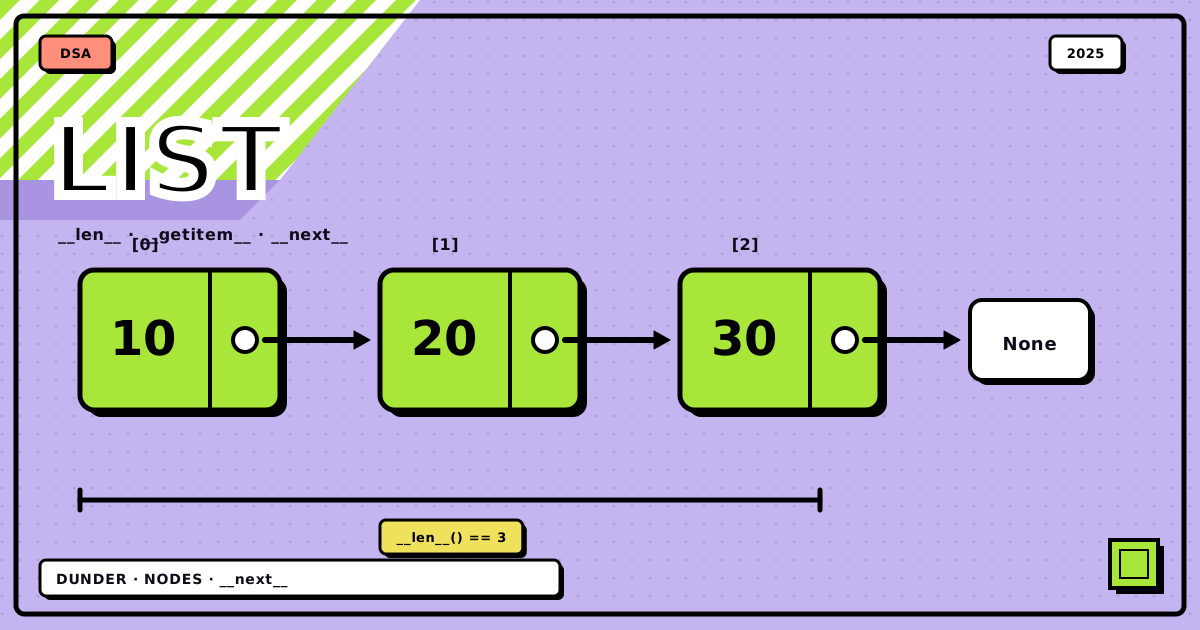
A few weeks back I was drilling linked-list problems for interview prep, and got tired of rewriting the same node-walking boilerplate for every variant. So I built one reusable LinkedList class to bring into any problem. First pass worked fine on its own. Then I tried to drop it into a test harness that did things like assert list(result) == expected and sum(result), and it just… didn’t work. Python had no idea what to do with an object that only had a .append() method. It wasn’t a list, it was a bag of nodes with delusions, fair. So I went through the dunder methods one at a time until it actually was one.
This is that walkthrough, in the order I actually ran into each method, gotchas included.
the shape of the problem#
Every Python operation you take for granted on a list (len(), x[i], for x in ..., +) is really just Python calling a method with two underscores on each side. If your class doesn’t define that method, the operation either fails outright or falls back to something you didn’t ask for. Here’s the map from “thing you type” to “method Python actually calls” to “what happens inside the list”:
flowchart TD
    subgraph syntax ["what you type"]
        LEN["len(ll)"]
        IDX["ll[2]"]
        SETI["ll[2] = x"]
        DELI["del ll[2]"]
        INOP["10 in ll"]
        ADDOP["ll1 + ll2"]
        FOROP["for x in ll"]
        PRINTOP["print(ll)"]
    end

    subgraph dunders ["the dunder methods I wrote"]
        DLEN["__len__"]
        DGET["__getitem__"]
        DSET["__setitem__"]
        DDEL["__delitem__"]
        DCONT["__contains__"]
        DADD["__add__"]
        DITER["__iter__ / __next__"]
        DSTR["__str__ / __repr__"]
    end

    WALK["walk head → next → next ...<br/>via _get_node(index)"]

    LEN --> DLEN --> WALK
    IDX --> DGET --> WALK
    SETI --> DSET --> WALK
    DELI --> DDEL --> WALK
    INOP --> DCONT --> WALK
    ADDOP --> DADD --> WALK
    FOROP --> DITER --> WALK
PRINTOP --> DSTR --> WALKThat’s the whole post in one picture. Ten dunder methods, one traversal helper underneath all of them. Let’s go through them in the order I actually built them.
the node (barely worth its own heading)#
Every linked list needs somewhere to put the data:
class Node:
    """
    Represents a single node in the linked list.
    Contains data and a reference to the next node.
    """
    def __init__(self, data):
        self.data = data
        self.next = None  # points to the next node
Nothing to say here. Onward.
challenge 1: __init__ and the decision that saves two O(n) walks later#
My first draft of __init__ only tracked self.head. That’s technically a linked list. It’s also a linked list where appending means walking to the end every single time, and where len() means counting every node every single time. Both of those are things a real Python list does in O(1), so mine needed to as well:
class LinkedList:
    def __init__(self, initial_data=None):
        """
        Initialize an empty linked list.
        Optionally populate it from an iterable.
        """
        self.head = None    # first node
        self.tail = None    # last node, makes append O(1) instead of O(n)
        self.length = 0     # cached size, makes len() O(1) instead of O(n)

        if initial_data:
            for item in initial_data:
                self.append(item)
head, tail, length. Three fields, and each one exists because a naive version of some later method would otherwise cost O(n) for no reason. That’s the whole design decision, made once, up front, before I’d written a single dunder method.
challenge 2: printing the thing without embarrassment#
The default print(my_list) gives you <__main__.LinkedList object at 0x7f...>, which is useless for debugging and useless for users. Python actually wants two different answers here, for two different audiences: __str__ for a human reading output, __repr__ for a developer in a debugger who ideally wants something they could paste back into a REPL to recreate the object.
def __str__(self):
    """User-friendly representation for print()."""
    if not self.head:
        return "[]"

    nodes = []
    current = self.head
    while current:
        nodes.append(str(current.data))
        current = current.next
    return f"[{' -> '.join(nodes)}]"

def __repr__(self):
    """Developer-friendly representation for debugging."""
    if not self.head:
        return "LinkedList([])"

    items = []
    current = self.head
    while current:
        items.append(repr(current.data))
        current = current.next
    return f"LinkedList([{', '.join(items)}])"
my_list = LinkedList(['a', 'b', 'c'])
print(my_list)        # [a -> b -> c]
print(repr(my_list))  # LinkedList(['a', 'b', 'c'])
Same traversal logic, twice, because the two audiences want different strings. I used to skip __repr__ and just alias it to __str__. Don’t do that. The moment you’re staring at a list of custom objects inside a debugger or a pytest failure, repr() is what gets printed for every element, and <Foo object at 0x...> times fifty is not a fun read.
challenge 3: __len__, the one you get for free#
Because I already cache self.length in __init__, this one is almost insultingly easy:
def __len__(self):
    """Enable len(my_list). O(1) because we cache the length."""
    return self.length
This is the whole payoff of the design decision back in challenge 1. If I hadn’t cached length, this method would walk the entire chain counting nodes, which defeats the point of len() existing as a fast, universal query.
challenge 4: indexing like a real list#
This is where things get real. my_list[2] and my_list[2] = "x" both need to find the node at index 2, which means walking from head some number of times. I wrote that walk once, as a private helper, and both dunders lean on it:
def _get_node(self, index):
    """
    Internal helper to get the node at a specific index.
    Handles negative indices like Python lists.
    """
    if not (-self.length <= index < self.length):
        raise IndexError("Linked list index out of range")

    if index < 0:
        index += self.length  # convert negative to positive

    current = self.head
    for _ in range(index):
        current = current.next
    return current
def __getitem__(self, index):
    """Enable my_list[index] to retrieve items."""
    node = self._get_node(index)
    return node.data

def __setitem__(self, index, value):
    """Enable my_list[index] = value to set items."""
    node = self._get_node(index)
    node.data = value
my_list = LinkedList([10, 20, 30])
print(my_list[1])     # 20
print(my_list[-1])    # 30
my_list[0] = 15
print(my_list)        # [15 -> 20 -> 30]
The bounds check and the negative-index conversion in _get_node matter more than they look. Skip the bounds check and my_list[-100] walks backward off the front of the list into a None.next AttributeError instead of a clean IndexError. That’s the kind of bug that looks fine in every test you write until someone else’s code does exactly that.
challenge 5: __delitem__, or how little new code you actually need#
By the time I got here I already had a working pop(index) method (more on that below), so del my_list[i] was a one-liner:
def __delitem__(self, index):
    """Enable del my_list[index]. Leans on our existing pop()."""
    self.pop(index)
my_list = LinkedList(['a', 'b', 'c', 'd'])
del my_list[1]  # removes 'b'
print(my_list)  # [a -> c -> d]
Worth noticing: this dunder didn’t need any new traversal logic. It just gave a name Python already understands to a method I’d have written anyway.
challenge 6: __contains__ and the in keyword#
Without __contains__, x in my_list would still technically work, because Python falls back to __iter__ and checks every yielded value. But writing it explicitly documents the intent and, if your data structure ever supports a faster lookup (a hash index, a sorted invariant), gives you a place to put that optimization later:
def __contains__(self, item):
    """Enable 'item in my_list' checks."""
    current = self.head
    while current:
        if current.data == item:
            return True
        current = current.next
    return False
my_list = LinkedList([1, 2, 3])
print(2 in my_list)     # True
print(99 in my_list)    # False
For a singly linked list there’s no faster way to do this than O(n), so honestly this method buys you ergonomics, not speed. Still worth it.
challenge 7: __add__ without mutating either side#
I wanted list1 + list2 to behave the way it does for real lists: produce a brand-new list, leave both originals untouched. That last part is the part people get wrong under time pressure, myself included on my first attempt, where I accidentally had new_list alias self instead of copying it.
def __add__(self, other):
    """
    Enable my_list + other for concatenation.
    Returns a NEW list, leaving originals unchanged.
    """
    new_list = LinkedList()

    current = self.head
    while current:
        new_list.append(current.data)
        current = current.next

    if isinstance(other, LinkedList):
        current = other.head
        while current:
            new_list.append(current.data)
            current = current.next
    elif hasattr(other, "__iter__"):
        for item in other:
            new_list.append(item)
    else:
        raise TypeError(f"Cannot concatenate LinkedList with {type(other)}")

    return new_list
list1 = LinkedList([1, 2])
list2 = LinkedList([3, 4])
list3 = list1 + list2
print(list3)  # [1 -> 2 -> 3 -> 4]
print(list1)  # [1 -> 2] (unchanged)
The hasattr(other, "__iter__") branch is the bit I’d skip if I were being lazy, but it’s what lets my_list + [5, 6] work against a plain Python list too, not just another LinkedList. Small thing, makes the class feel less brittle.
challenge 8: __iter__ and __next__, the one that took two classes#
This is the method that actually makes for item in my_list: work, and it’s the one dunder here where I had to stop and read the iterator protocol properly instead of guessing.
The rule: __iter__ must return an iterator, an object with its own __next__. It’s tempting to just return self and add a __next__ directly on LinkedList, and I did that on my first pass. It breaks the moment you try to iterate the same list twice at once, say in a nested loop, because there’s only one iteration position shared across both loops. So I split it into a dedicated iterator class instead:
class LinkedListIterator:
    """
    Iterator for LinkedList. Maintains iteration state
    separately from the list itself.
    """
    def __init__(self, head_node):
        self._current = head_node

    def __iter__(self):
        """An iterator must return itself."""
        return self

    def __next__(self):
        """Return next item or raise StopIteration."""
        if self._current is None:
            raise StopIteration

        data = self._current.data
        self._current = self._current.next
        return data
def __iter__(self):
    """Return a fresh iterator object on every call."""
    return LinkedListIterator(self.head)
my_list = LinkedList(['x', 'y', 'z'])

for item in my_list:
    print(item)  # x, y, z

squares = [x**2 for x in LinkedList([1, 2, 3])]
py_list = list(my_list)
total = sum(LinkedList([10, 20, 30]))  # 60
That last line is the actual point of this whole exercise. sum() has never heard of LinkedList. It just calls iter() on whatever you hand it and keeps calling next() until StopIteration. Once __iter__ and __next__ exist, every built-in that accepts an iterable accepts your object for free: sum, max, sorted, list, comprehensions, unpacking, all of it.
challenge 9: __del__, the dunder method you should barely touch#
I added __del__ mostly out of curiosity, to see when it actually fires. Welp, turns out the honest answer is “whenever the garbage collector feels like it”:
def __del__(self):
    """
    Called when the object is about to be garbage collected.
    Timing is non-deterministic, do not rely on it for cleanup.
    """
    print(f"LinkedList object {id(self)} destroyed")
__del__ runs whenever the garbage collector gets around to it, which is not a moment you control, and in some situations (reference cycles, interpreter shutdown) might not run at all in any useful order. For predictable cleanup, use a context manager instead:
class ResourceHolder:
    def __enter__(self):
        # acquire resource
        return self

    def __exit__(self, exc_type, exc_val, exc_tb):
        # release resource, deterministically
        pass

with ResourceHolder() as holder:
    pass  # cleanup happens here, guaranteed
I left __del__ in the final version purely as a debugging print. If your object is holding a file handle, a socket, or a lock, __del__ is the wrong tool, full stop. __enter__/__exit__ exist precisely because “eventually, probably” isn’t a cleanup guarantee anyone should accept.
the methods the dunders were quietly leaning on#
Every dunder above calls into a handful of ordinary methods that aren’t dunders themselves, they’re just the linked-list mechanics everyone expects: append, prepend, insert, remove, pop. __init__ calls append. __delitem__ calls pop. __add__ calls append on the new list, twice. None of the dunder magic works without these underneath it.
def append(self, data):  # O(1)
    """Add element to the end."""
    new_node = Node(data)

    if not self.head:
        self.head = new_node
        self.tail = new_node
    else:
        self.tail.next = new_node
        self.tail = new_node

    self.length += 1

def prepend(self, data):  # O(1)
    """Add element to the beginning."""
    new_node = Node(data)

    if not self.head:
        self.head = new_node
        self.tail = new_node
    else:
        new_node.next = self.head
        self.head = new_node

    self.length += 1

def insert(self, index, data):  # O(n)
    """Insert element at a specific index."""
    if index < 0:
        if abs(index) > self.length:
            raise IndexError("Index out of range")
        index += self.length

    if index == 0:
        self.prepend(data)
    elif index >= self.length:
        self.append(data)
    else:
        new_node = Node(data)
        prev = self._get_node(index - 1)
        new_node.next = prev.next
        prev.next = new_node
        self.length += 1

def remove(self, data):  # O(n)
    """Remove first occurrence of data."""
    if not self.head:
        raise ValueError(f"{data} not in list")

    if self.head.data == data:
        if self.head == self.tail:
            self.head = None
            self.tail = None
        else:
            self.head = self.head.next
        self.length -= 1
        return

    current = self.head
    while current.next and current.next.data != data:
        current = current.next

    if current.next:
        if current.next == self.tail:
            self.tail = current
        current.next = current.next.next
        self.length -= 1
    else:
        raise ValueError(f"{data} not in list")

def pop(self, index=-1):  # O(n)
    """Remove and return the element at index."""
    if self.length == 0:
        raise IndexError("pop from empty list")

    if index < 0:
        index += self.length

    if not (0 <= index < self.length):
        raise IndexError("Index out of range")

    if index == 0:
        data = self.head.data
        if self.head == self.tail:
            self.head = None
            self.tail = None
        else:
            self.head = self.head.next
    else:
        prev = self._get_node(index - 1)
        data = prev.next.data
        if prev.next == self.tail:
            self.tail = prev
        prev.next = prev.next.next

    self.length -= 1
    return data
Nothing exotic here. It’s the same head-pointer, tail-pointer bookkeeping repeated with slightly different edge cases each time (empty list, removing the head, removing the tail). The tail-pointer maintenance is the part I got wrong twice while writing this: forget to reset self.tail when you pop or remove the last node, and the next append() silently writes to a node that’s no longer reachable from head. That bug doesn’t crash. It just makes your list quietly shorter than self.length claims, which is a nasty one to track down, yk.
does it actually behave like a Python list?#
This was the actual test, the thing I opened this post complaining about:
my_list = LinkedList([1, 2, 3, 4, 5])

print(len(my_list))  # 5

print(my_list[2])    # 3
my_list[2] = 10
print(my_list)       # [1 -> 2 -> 10 -> 4 -> 5]

print(10 in my_list) # True

del my_list[2]
print(my_list)       # [1 -> 2 -> 4 -> 5]

for item in my_list:
    print(item)      # 1, 2, 4, 5

other = LinkedList([6, 7])
combined = my_list + other
print(combined)      # [1 -> 2 -> 4 -> 5 -> 6 -> 7]

total = sum(my_list)        # 12
maximum = max(my_list)      # 5
py_list = list(my_list)     # [1, 2, 4, 5]

my_list.append(99)
my_list.prepend(0)
my_list.insert(2, 1.5)
my_list.remove(4)
popped = my_list.pop()
Every one of those lines is a built-in Python operation or function that has never seen LinkedList before, working anyway.
what it costs#
None of this is free. Here’s the honest complexity, method by method:
| Operation | Time complexity |
|---|---|
append() |
O(1) |
prepend() |
O(1) |
insert(index, item) |
O(n) |
__getitem__[index] |
O(n) |
__setitem__[index] |
O(n) |
__delitem__[index] |
O(n) |
remove(item) |
O(n) |
pop(index) |
O(n) |
__contains__ (in) |
O(n) |
__len__ |
O(1) |
That O(n) row for __getitem__ is the one that trips people coming from arrays: a Python list gives you O(1) random access because it’s backed by contiguous memory. A linked list never will, no matter how clever the dunder methods look on the surface. If your workload is index-heavy, a linked list is the wrong structure, dunder methods or not. What they buy you is that the syntax looks the same, not that the performance does. Don’t let a nice __getitem__ implementation talk you out of that.
the checklist#
When to actually implement each of these
-
__len__: implement it the moment you cache a size anywhere. Don’t make callers use a.get_length()method for somethinglen()should answer directly -
__getitem__: implement it if the object is genuinely a sequence. Only add__setitem__if index-assignment is a real use case for your type, not just for symmetry with__getitem__ -
__delitem__: pair it with__getitem__/__setitem__ifdel obj[i]is a natural operation; it can almost always just call an existingpop()orremove() -
__contains__: write it explicitly if you can check membership faster than the default__iter__fallback would. If not (like here), it’s still worth it for theinergonomics alone -
__add__: only overload it when addition is genuinely unambiguous for your type. If you’d need a comment to explain what+means for your object, don’t overload it -
__iter__: implement it whenever people will loop over your object. Return a real iterator with its own__next__, notself, unless the object truly supports only one iteration pass ever -
__del__: skip it almost always. A debug print is fine. Resource cleanup is not; use__enter__/__exit__for that
testing it for real#
The full test suite
def test_linked_list():
    ll = LinkedList()
    assert len(ll) == 0
    assert str(ll) == "[]"

    ll.append(1)
    ll.append(2)
    ll.prepend(0)
    assert list(ll) == [0, 1, 2]

    assert ll[0] == 0
    assert ll[-1] == 2
    ll[1] = 10
    assert ll[1] == 10

    assert 10 in ll
    assert 99 not in ll

    del ll[0]
    assert list(ll) == [10, 2]

    ll2 = LinkedList([3, 4])
    ll3 = ll + ll2
    assert list(ll3) == [10, 2, 3, 4]

    ll.insert(1, 1)
    assert list(ll) == [10, 1, 2]

    ll.remove(1)
    assert list(ll) == [10, 2]

    popped = ll.pop()
    assert popped == 2
    assert list(ll) == [10]

    print("All tests passed")

test_linked_list()
bottom line: dunder methods aren’t a checklist you complete, they’re a translation layer between “what Python already knows how to do” and “what your object actually does underneath.” Implement the ones your object’s usage pattern actually needs, in the order you actually hit them, and skip the ones that only exist for the sake of looking complete. Ten methods and one traversal helper turned a bag of nodes into something sum(), max(), for, in, + and len() all accept without a single special case written on their end. That’s the whole trick, and it generalizes to trees, queues, whatever custom container you build next.
if you take one thing from this: implement __iter__ properly, with a real iterator object, the first time. saves you a weird bug in a nested loop three weeks later.
Discussion
0Leave a comment