FastAPI Application
Purpose and Scope
This document details the main FastAPI application structure defined in api/main.py It covers the application initialization, the modular router architecture, and how the 9 service-specific routers are mounted to create the API surface. For details on individual router implementations and the services they expose, see Service Integration Routers. For information about project dependencies and the LargeLanguageModel abstraction, see Project Structure and Dependencies.
Sources: api/main.py1-43
Application Initialization
The FastAPI application is instantiated in api/main.py13 with basic metadata:
app = FastAPI(title="Agentic Browser API", version="0.1.0")
The application uses a logger configured through the core.config module (api/main.py3-10). This logger instance is used throughout the application for consistent logging behavior.
Sources: api/main.py1-13
Router Architecture
Modular Router Design
The application follows a modular router pattern where each service integration is implemented as a separate APIRouter instance in the routers/ package. This design provides:
- Separation of concerns: Each router handles a distinct service domain
- Independent development: Routers can be developed and tested in isolation
- Clean namespace organization: URL prefixes clearly indicate service boundaries
- Easy extensibility: New services can be added by creating a new router module
The routers are imported from the routers package (api/main.py16-26) and mounted onto the main application using the include_router method with distinct URL prefixes.
Sources: api/main.py16-36
Mounted Routers Overview
The application mounts 9 routers, each serving a specific integration or functionality:
| Router Variable | Module | URL Prefix | Purpose |
|---|---|---|---|
health_router |
routers.health |
/api/genai/health |
Health check endpoints for monitoring application status |
github_router |
routers.github |
/api/genai/github |
GitHub repository analysis and code crawling |
website_router |
routers.website |
/api/genai/website |
Website content extraction and markdown conversion |
youtube_router |
routers.youtube |
/api/genai/youtube |
YouTube video transcript and metadata retrieval |
google_search_router |
routers.google_search |
/api/google-search |
Google search integration and result processing |
gmail_router |
routers.gmail |
/api/gmail |
Gmail operations (list, send, mark read) |
calendar_router |
routers.calendar |
/api/calendar |
Google Calendar event management |
pyjiit_router |
routers.pyjiit |
/api/pyjiit |
JIIT student portal integration |
react_agent_router |
routers.react_agent |
/api/genai/react |
React agent orchestration and LLM interaction |
Sources: api/main.py16-36 routers/__init__.py1-25
Router Mounting Structure
Diagram: FastAPI Router Mounting Architecture
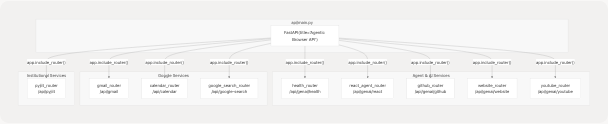
Each router is mounted using the pattern:
app.include_router(router_instance, prefix="/api/path")
This creates a hierarchical URL structure where all endpoints defined in the router are automatically prefixed with the specified path.
Sources: api/main.py28-36
URL Prefix Convention
The application uses two primary URL prefix patterns:
/api/genai/* Prefix
Routes under this prefix are AI/agent-centric services that typically involve LLM processing or intelligent automation:
/api/genai/health- Application health monitoring/api/genai/react- React agent execution/api/genai/github- GitHub repository analysis/api/genai/website- Intelligent website content extraction/api/genai/youtube- YouTube content analysis
/api/<service> Prefix
Routes under this pattern are direct service integrations without AI mediation:
/api/gmail- Gmail API operations/api/calendar- Google Calendar operations/api/google-search- Web search functionality/api/pyjiit- JIIT portal operations
Sources: api/main.py28-36
Router Module Organization
Diagram: Router Package Structure
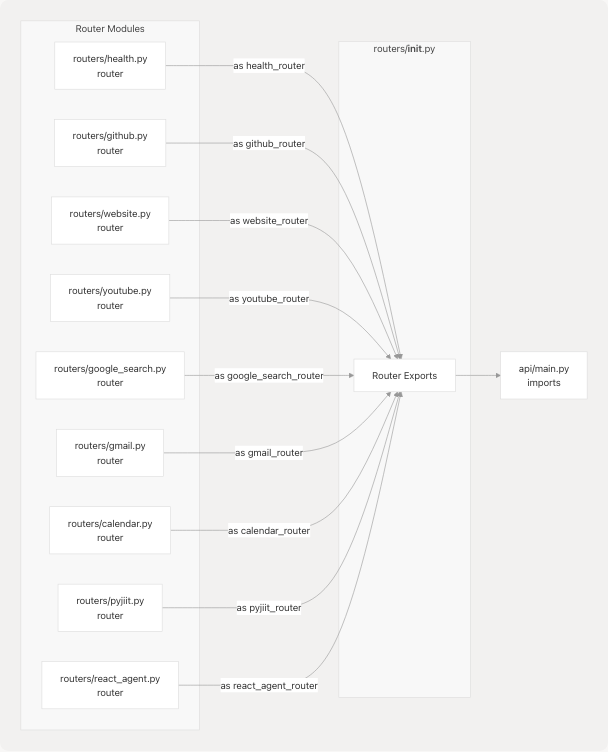
The routers/__init__.py module (routers/__init__.py1-25) serves as a central export point that:
- Imports the
routerinstance from each router module - Aliases each router with a descriptive suffix (e.g.,
router as github_router) - Exports all routers through the
__all__list for clean imports
This pattern allows the main application to import all routers in a single statement:
from routers import (
    github_router,
    health_router,
    # ... other routers
)
Sources: routers/__init__.py1-25 api/main.py16-26
Root Endpoint
The application provides a simple root endpoint at / (api/main.py40-42):
@app.get("/")
def root():
    return {"name": app.title, "version": app.version}
This endpoint returns basic application metadata and can be used for quick connectivity checks.
Sources: api/main.py40-42
Request Flow Architecture
Diagram: HTTP Request Processing Flow
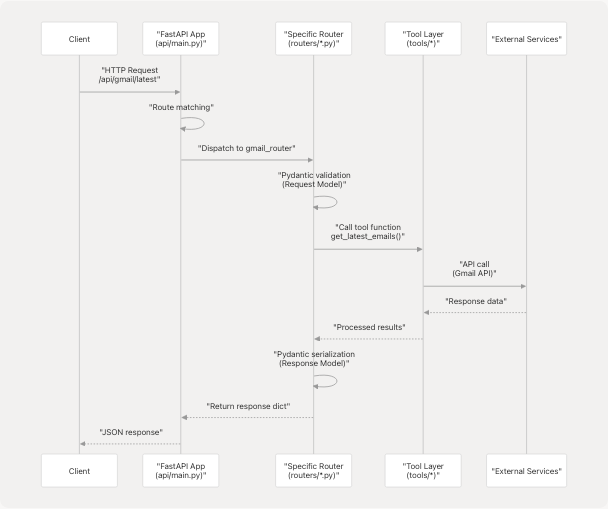
The request processing follows this pattern:
- Route Matching: FastAPI matches the incoming URL to a router prefix
- Router Dispatch: The request is handed to the appropriate router
- Request Validation: Pydantic models validate incoming request bodies
- Tool Invocation: Router calls the appropriate tool/service function
- External Integration: Tool functions interact with external services
- Response Serialization: Results are formatted using response models
- JSON Response: FastAPI serializes and returns the response
Sources: api/main.py28-36 routers/gmail.py37-60
Router Implementation Pattern
Each router module follows a consistent structure. Example from the Gmail router (routers/gmail.py1-60):
Request Models: Define input schemas using Pydantic
class UnreadRequest(TokenRequest):
    access_token: str
    max_results: Optional[int] = 10
Endpoint Definition: Use FastAPI decorators and dependency injection
@router.post("/unread", response_model=dict)
async def list_unread_messages(request: UnreadRequest):
    # Implementation
Error Handling: Catch exceptions and return appropriate HTTP errors
except Exception as e:
    logger.exception("Error listing unread messages: %s", e)
    raise HTTPException(status_code=500, detail=str(e))
Tool Integration: Delegate to service-specific tool functions
results = list_unread(request.access_token, max_results=request.max_results)
This pattern ensures consistency across all routers while allowing flexibility in implementation details.
Sources: routers/gmail.py1-60 routers/pyjiit.py1-54
Service Integration Categories
Diagram: Router Service Categories
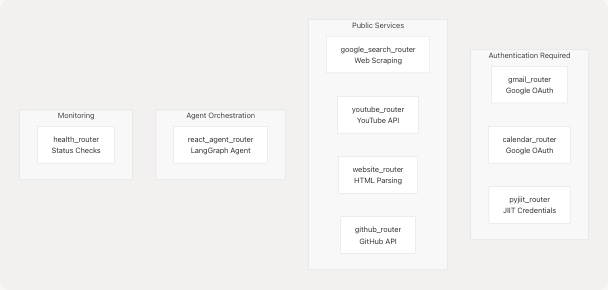
The routers are organized into functional categories:
Authentication-Required Services: Require user credentials or OAuth tokens
gmail_router: Requires Google OAuth access token in request bodycalendar_router: Requires Google OAuth access token in request bodypyjiit_router: Requires JIIT webportal credentials
Public Services: Can be called without user authentication
google_search_router: Web search and scrapingyoutube_router: Public video metadata and transcriptswebsite_router: HTML to Markdown conversiongithub_router: Public repository analysis
Agent Orchestration: Coordinates LLM-based intelligent task execution
react_agent_router: Executes React agent pattern with dynamic tool selection
Monitoring: Application health and status
health_router: Health check endpoints
Sources: api/main.py28-36 routers/gmail.py15-34 routers/pyjiit.py17-38
Extension Points
The modular router architecture provides clear extension points:
Adding New Routers:
- Create a new router module in
routers/(e.g.,routers/new_service.py) - Define an
APIRouterinstance namedrouter - Implement endpoints with appropriate request/response models
- Export the router in
routers/__init__.pywith a descriptive alias - Mount the router in api/main.py using
app.include_router()
Extending Existing Routers:
- Add new endpoint functions to the router module
- Define additional Pydantic models for new request/response schemas
- Implement corresponding tool functions in the
tools/package
This architecture keeps the main application file minimal and maintainable while allowing unlimited service expansion.
Sources: api/main.py16-36 routers/__init__.py1-25