GitHub Integration
Purpose and Scope
This document describes the GitHub integration subsystem, which provides repository crawling and question-answering capabilities using the gitingest library. The system follows the standard router-service-tool architecture pattern, exposing a FastAPI endpoint that processes GitHub repository URLs and answers questions about the codebase using LLM-based analysis.
For information about other API routers, see API Routers. For details on the LLM integration used by this service, see LLM Integration Layer.
Architecture Overview
The GitHub integration follows a three-tier architecture where the router handles HTTP concerns, the service implements business logic, and the tool layer interacts with external systems.
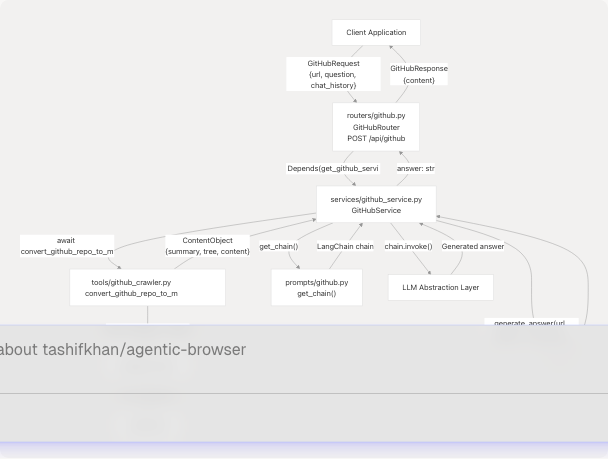
Sources: routers/github.py1-48 services/github_service.py1-40
API Endpoint
The GitHub router exposes a single POST endpoint at /api/github/ that accepts repository analysis requests.
Endpoint Specification
| Property | Value |
|---|---|
| Path | /api/github/ |
| Method | POST |
| Request Model | GitHubRequest |
| Response Model | GitHubResponse |
| Service Injection | Depends(get_github_service) |
Router Implementation
The router performs input validation and delegates processing to the GitHubService:
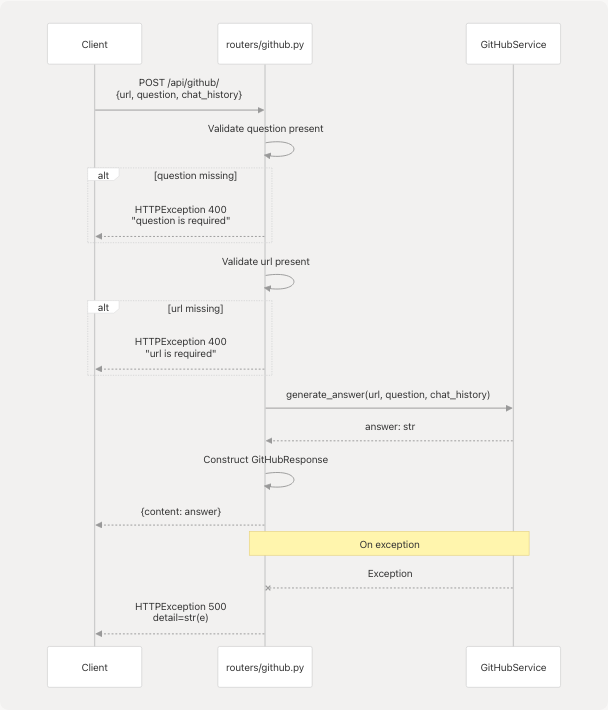
The router implementation at routers/github.py16-47 follows this flow:
- Extract
question,chat_history, andurlfrom theGitHubRequest - Validate that
questionis not empty - Validate that
urlis not empty - Convert
urlstring toHttpUrltype - Call
service.generate_answer()with validated parameters - Return response wrapped in
GitHubResponsemodel - Catch exceptions and convert to HTTP 500 errors
Sources: routers/github.py1-48
Service Layer
The GitHubService class encapsulates the business logic for repository analysis and question answering.
Service Architecture
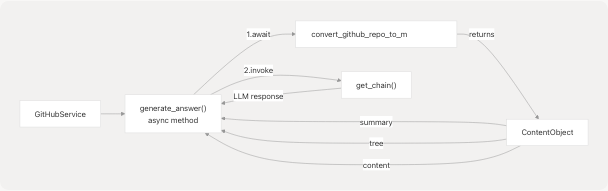
generate_answer Method
The core method signature is:
async def generate_answer(
    self,
    url: HttpUrl,
    question: str,
    chat_history: list[dict] = [],
) -> str
Implementation flow at services/github_service.py11-39:
- Repository Conversion: Calls
await convert_github_repo_to_markdown(url)to fetch repository content - Chain Creation: Calls
get_chain()to obtain a configured LangChain prompt chain - Chain Invocation: Invokes the chain with parameters:
summary: Repository summary from ContentObjecttree: File tree structure from ContentObjecttext: Full content from ContentObjectquestion: User's questionchat_history: Conversation history (empty string if not provided)
- Response Extraction: Returns
response.contentif response is not a string, otherwise returns the response directly - Error Handling: Catches all exceptions, logs them, and returns a friendly error message
Sources: services/github_service.py1-40
Repository Crawling with gitingest
The convert_github_repo_to_markdown() function in the tool layer uses the gitingest library to analyze GitHub repositories.
Crawling Process
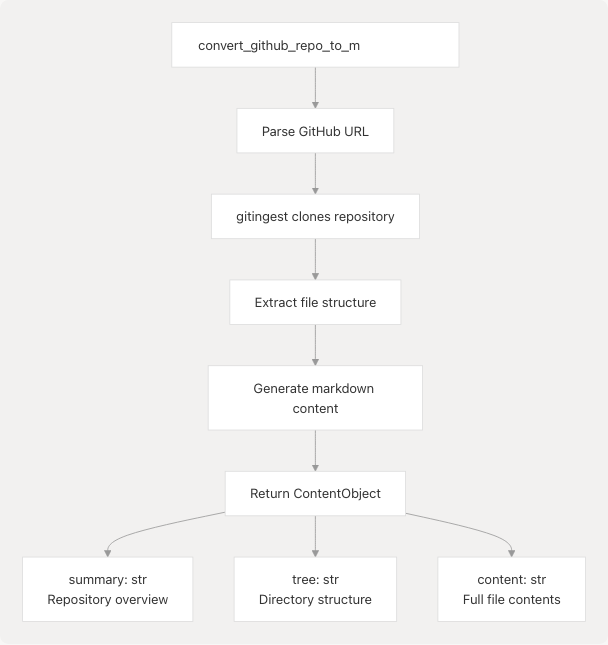
The gitingest library provides:
- Automated Cloning: Clones the repository to analyze its structure
- File Tree Generation: Creates a hierarchical representation of the repository structure
- Content Extraction: Extracts and combines file contents into a single markdown document
- Summary Generation: Provides a high-level overview of the repository
The returned ContentObject contains three key fields:
summary: Brief description of the repositorytree: ASCII tree representation of the file structurecontent: Concatenated markdown of all relevant files
Sources: services/github_service.py19
LLM-Based Question Answering
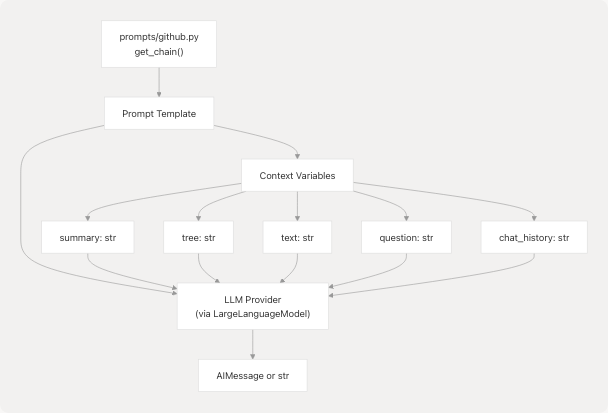
The service uses a LangChain prompt chain to answer questions about the repository using the extracted content.
Prompt Chain Flow
Chain Invocation
The chain is invoked at services/github_service.py22-30 with a dictionary containing:
| Parameter | Source | Description |
|---|---|---|
summary |
content_obj.summary |
Repository overview from gitingest |
tree |
content_obj.tree |
Directory structure |
text |
content_obj.content |
Full file contents in markdown |
question |
Function parameter | User's question about the repository |
chat_history |
Function parameter | Previous conversation context (empty string if none) |
The prompt template (defined in prompts/github.py) structures these inputs to guide the LLM in providing accurate answers based on the repository content.
Sources: services/github_service.py11-39
Request and Response Models
The API uses Pydantic models for type-safe request/response handling.
GitHubRequest Model
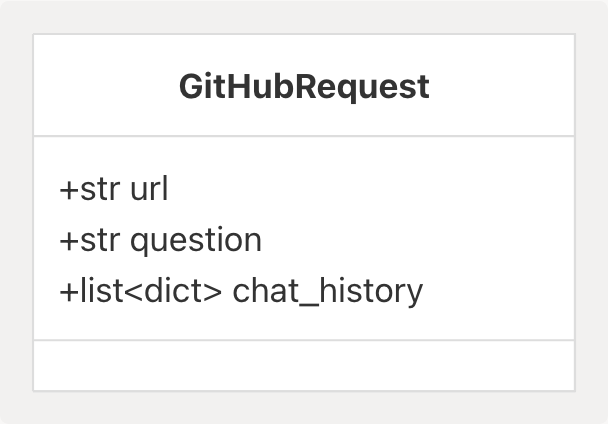
Defined in models/requests/github.py this model requires:
url: GitHub repository URL (validated as string, converted toHttpUrlin router)question: The question to answer about the repositorychat_history: Optional list of previous conversation messages
GitHubResponse Model
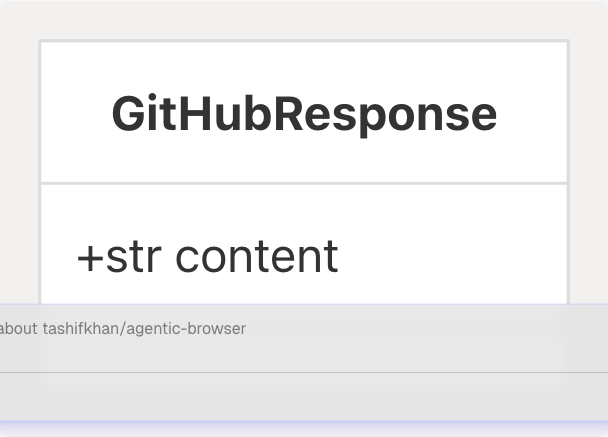
Defined in models/response/gihub.py this model contains:
content: The generated answer from the LLM
Sources: routers/github.py4-5
Error Handling
The GitHub integration implements comprehensive error handling at both the router and service layers.
Error Handling Strategy
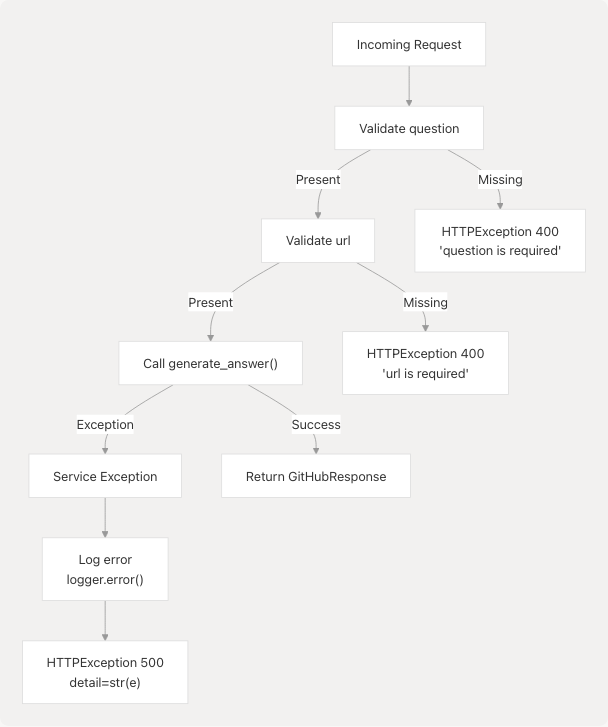
Router-Level Error Handling
- Validation Errors: Returns HTTP 400 with descriptive error messages for missing required fields
- Service Exceptions: Catches all exceptions, logs them, and returns HTTP 500 with exception details
Service-Level Error Handling
At services/github_service.py37-39:
- Exception Logging: Uses
logger.error()to record all errors with full details - Friendly Error Messages: Returns a user-friendly message instead of exposing internal errors
- Exception Re-raising: Allows router to handle HTTP status codes while service focuses on logging
Error Response Pattern
All errors follow the FastAPI standard HTTPException pattern:
{
  "detail": "Error description string"
}
Sources: routers/github.py20-47 services/github_service.py37-39
Dependency Injection
The router uses FastAPI's dependency injection system to obtain service instances.
Dependency Function
The get_github_service() function at routers/github.py12-13 provides a factory for GitHubService instances:
def get_github_service():
    return GitHubService()
This dependency is injected into the endpoint handler at routers/github.py18:
async def github_crawler(
    request: GitHubRequest,
    service: GitHubService = Depends(get_github_service)
):
This pattern enables:
- Testability: Easy to mock service in unit tests
- Separation of Concerns: Router doesn't manage service lifecycle
- Consistency: Follows the same pattern as other routers (Gmail, Calendar, YouTube, etc.)
Sources: routers/github.py12-18
Integration with Agent System
The GitHub functionality is also exposed as an agent tool for use by the React Agent system (see Agent Tool System).

The github_agent tool wraps the same service logic, allowing the React Agent to autonomously analyze GitHub repositories as part of multi-step reasoning workflows.
Sources: services/github_service.py1-40