Google Search and Web Scraping
Purpose and Scope
This document covers the Google Search and Web Scraping functionality of the Agentic Browser system. This service provides the ability to query Google search, retrieve result URLs, fetch HTML content from those URLs, and convert the HTML to clean markdown format for downstream processing by AI agents.
The system consists of two main components:
- FastAPI Router (routers/google_search.py) - HTTP endpoint for search requests
- Search Pipeline (tools/google_search/seach_agent.py) - Core search and extraction logic
For information about how this integrates with the agent intelligence system, see Agent Intelligence System. For details on the LLM abstraction used with this data, see LLM Integration.
Architecture Overview
The Google Search and Web Scraping system follows a multi-stage pipeline architecture that transforms user queries into structured markdown content extracted from web pages.
System Flow Diagram
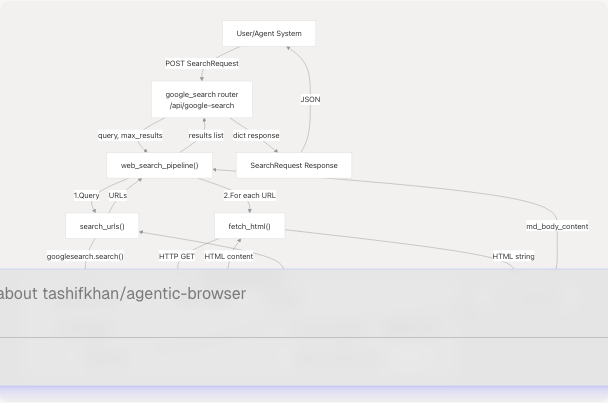
Sources: routers/google_search.py tools/google_search/seach_agent.py
API Router Endpoint
The router exposes a single GET endpoint at /api/google-search/ that accepts search parameters and returns structured results.
Request Model
| Field | Type | Default | Description |
|---|---|---|---|
query |
str |
Required | The search query string |
max_results |
int |
5 |
Maximum number of results to return |
The SearchRequest model is defined at routers/google_search.py12-14
Endpoint Handler

The endpoint handler at routers/google_search.py17-47 performs:
- Validation - Checks if
queryis provided, raisesHTTPException(400)if missing - Logging - Logs request parameters using the
loggerinstance - Pipeline Invocation - Calls
web_search_pipeline()with query and max_results - Result Processing - Wraps results in a dictionary with key
"results" - Error Handling - Catches exceptions and converts to
HTTPException(500)
Sources: routers/google_search.py17-47
Web Search Pipeline
The web_search_pipeline() function at tools/google_search/seach_agent.py138-162 orchestrates the complete search-to-markdown workflow.
Pipeline Stages

Stage 1: URL Discovery
The search_urls() function at tools/google_search/seach_agent.py57-66 and its underlying implementation search_and_get_urls() at tools/google_search/seach_agent.py23-54 use the googlesearch library to query Google.
Key implementation details:
- Uses
googlesearch.search()generator with parameters:query- User's search querynum_results- Number of results to fetchlang="en"- Search language set to English
- Iterates through results and collects URLs into a list
- Implements error handling for rate limiting exceptions
- Logs search progress and final URL count
Sources: tools/google_search/seach_agent.py23-66
Stage 2: Content Extraction
The get_cleaned_texts() function at tools/google_search/seach_agent.py105-126 processes the URL list to extract and clean content.
Processing flow:

Sources: tools/google_search/seach_agent.py105-126
HTML Fetching
The fetch_html() function at tools/google_search/seach_agent.py69-89 retrieves raw HTML content from web pages.
Implementation Details
| Aspect | Implementation |
|---|---|
| HTTP Library | requests |
| Timeout | 30 seconds |
| User-Agent | Mozilla/5.0 Chrome 91.0 |
| Error Handling | Returns empty string "" on failure |
| Status Check | response.raise_for_status() |
Key features:
- User-Agent Spoofing - Uses a realistic browser user-agent string to avoid bot detection (tools/google_search/seach_agent.py74-76)
- Timeout Protection - 30-second timeout prevents indefinite hanging (tools/google_search/seach_agent.py82)
- Exception Safety - All exceptions are caught and logged, returning empty string instead of propagating errors (tools/google_search/seach_agent.py87-89)
Sources: tools/google_search/seach_agent.py69-89
Markdown Conversion
The system converts fetched HTML to markdown format using the html_md_convertor function from the website_context module.
Conversion Function
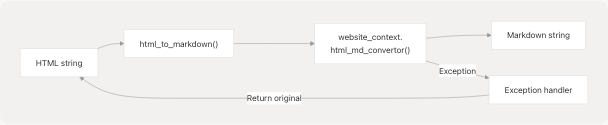
The html_to_markdown() function at tools/google_search/seach_agent.py92-102 serves as a wrapper around the actual conversion logic.
Error handling strategy:
- If conversion fails, returns the original HTML string instead of markdown
- Logs exception details for debugging
- Ensures the pipeline never fails due to conversion errors
There is also a standalone extract_text_from_url() function at tools/google_search/seach_agent.py129-135 that combines fetching and conversion for single-URL extraction.
Sources: tools/google_search/seach_agent.py92-135
Integration with Agent System
The Google Search functionality integrates with the broader agent system through both direct API calls and as an agent tool.
Usage Patterns
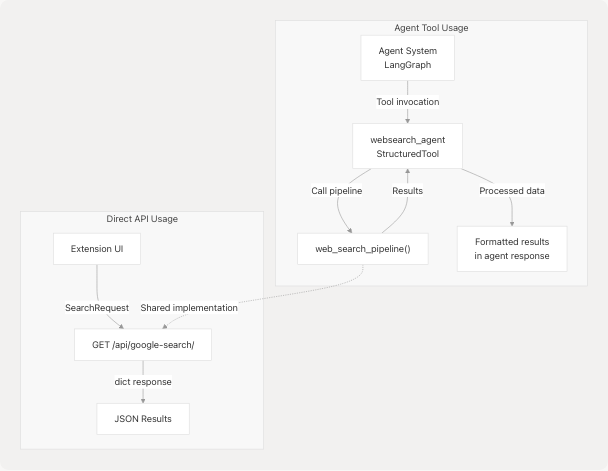
The web_search_pipeline() function is used as the core implementation for:
- Direct HTTP API - Via the
/api/google-search/endpoint - Agent Tool - As part of the
websearch_agenttool in the agent system (see Tool System)
Sources: routers/google_search.py tools/google_search/seach_agent.py
Error Handling and Logging
The system implements comprehensive error handling and logging at multiple levels.
Logging Architecture

Error Scenarios
| Component | Error Type | Handling Strategy | User Impact |
|---|---|---|---|
| Router | Missing query | Raise HTTPException(400) |
Immediate error response |
| Router | Pipeline exception | Raise HTTPException(500) with details |
Error response with message |
| Search | Rate limiting | Log warning, return partial results | Reduced result count |
| Search | Network error | Log exception, return empty list | Empty results, no crash |
| Fetch | HTTP error | Log exception, return "" |
Skip URL, continue pipeline |
| Fetch | Timeout | Log exception, return "" |
Skip URL, continue pipeline |
| Convert | Conversion error | Log exception, return original HTML | Less clean output, no crash |
Key principles:
- Graceful degradation - Individual URL failures don't break the entire pipeline
- Detailed logging - All errors logged with full context for debugging
- Empty result handling - System distinguishes between "no results found" (valid) and "error occurred" (logged)
- Exception propagation - Only router-level exceptions propagate to client as HTTP errors
Sources: routers/google_search.py17-47 tools/google_search/seach_agent.py23-162 core/config.py22-25
Command-Line Interface
The search agent includes a standalone CLI for testing at tools/google_search/seach_agent.py165-182
Usage:
if __name__ == "__main__":
    search_query = input("Enter your search query: ")
    number_of_urls = int(input("How many URLs do you want? (e.g., 10): "))
    results = web_search_pipeline(search_query, max_results=number_of_urls)
This allows developers to test the search pipeline independently without running the full API server.