ATS Evaluation Service
Purpose and Scope
The ATS Evaluation Service scores resumes against job descriptions to predict how well they will perform in Applicant Tracking Systems. The service analyzes resume-JD compatibility, provides numerical scores (0-100), and generates actionable improvement suggestions. It leverages Google Gemini 2.0 Flash through a LangGraph state machine to perform semantic matching, keyword analysis, and company-specific tailoring recommendations.
For resume analysis and classification, see Resume Analysis Service. For generating tailored resumes based on ATS feedback, see Tailored Resume Service.
Service Overview
The ATS Evaluation Service operates as a two-layer architecture:
- Service Layer (backend/app/services/ats.py) - Validates inputs, handles JD retrieval from URLs, and normalizes outputs
- Evaluator Layer (backend/app/services/ats_evaluator/graph.py) - Executes LangGraph workflow with LLM and optional web research tools
The service accepts either raw job description text or a URL, fetches company website content for context, and returns a structured evaluation with score justification and improvement recommendations.
Sources: backend/app/services/ats.py1-214 backend/app/services/ats_evaluator/graph.py1-213
Data Models
Input Models
The service uses two request models depending on the calling context:
JDEvaluatorRequest
Primary request model used internally by the service layer:
| Field | Type | Required | Description |
|---|---|---|---|
company_name |
Optional[str] |
No | Company name for context |
company_website_content |
Optional[str] |
No | Pre-fetched website content |
jd |
str |
Yes | Job description text (min 1 char) |
jd_link |
Optional[str] |
No | Alternative to jd text |
resume |
str |
Yes | Resume text (min 1 char) |
ATSEvaluationRequest
Alternative request model for API endpoints:
| Field | Type | Required | Description |
|---|---|---|---|
resume_text |
str |
Yes | Full resume text |
jd_text |
str |
Yes | Job description text |
company_name |
Optional[str] |
No | Company name |
company_website |
Optional[str] |
No | Company website URL |
Sources: backend/app/models/schemas.py475-486 backend/app/models/schemas.py460-465
Output Models
JDEvaluatorResponse
Structured response returned by the service:
| Field | Type | Description |
|---|---|---|
success |
bool |
Operation success flag (default: True) |
message |
str |
Human-readable status message |
score |
int |
ATS compatibility score (0-100) |
reasons_for_the_score |
List[str] |
Justifications for the assigned score |
suggestions |
List[str] |
Actionable improvement recommendations |
The service normalizes all output to match this schema, handling edge cases like unparseable JSON or missing fields.
Sources: backend/app/models/schemas.py488-499
Service Architecture
Component Diagram
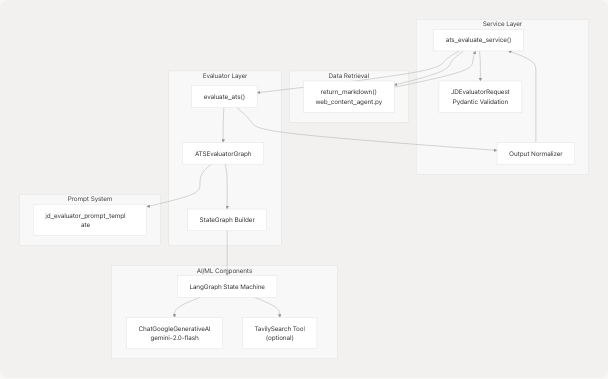
Sources: backend/app/services/ats.py24-192 backend/app/services/ats_evaluator/graph.py42-120
Service Layer Implementation
The ats_evaluate_service() function orchestrates the evaluation workflow:
- JD Retrieval - If
jd_linkis provided instead ofjd_text, fetches content viareturn_markdown()from the web content agent - Validation - Constructs
JDEvaluatorRequestto validate all inputs using Pydantic - Evaluation - Calls
evaluate_ats()with normalized inputs - Normalization - Parses JSON output, handles malformed responses, and ensures all required fields exist
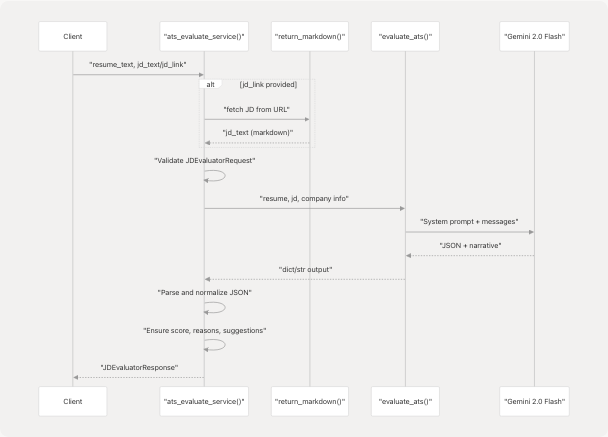
Sources: backend/app/services/ats.py24-113 backend/app/services/ats.py142-191
LangGraph State Machine Implementation
ATSEvaluatorGraph Class
The ATSEvaluatorGraph class in backend/app/services/ats_evaluator/graph.py48-120 encapsulates the LangGraph workflow:
Constructor Parameters:
resume_text: str- Full resume contentjd_text: str- Job descriptioncompany_name: str | None- Company name for researchcompany_website: str | None- Website URL to fetch viareturn_markdown()llm: ChatGoogleGenerativeAI | None- Optional LLM instance (uses sharedapp.core.llm.llmby default)config: GraphConfig | None- Model configuration (default:MODEL_NAME, temp 0.1)
Graph Architecture
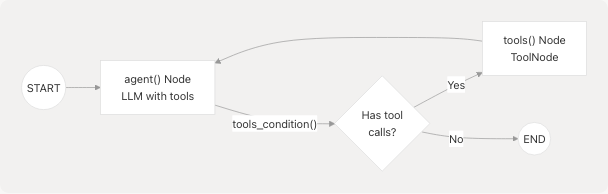
Sources: backend/app/services/ats_evaluator/graph.py98-116
Tool Integration
The graph conditionally binds TavilySearch if TAVILY_API_KEY is configured:
def _try_init_tavily() -> list:
    try:
        from langchain_tavily import TavilySearch
        return [TavilySearch(max_results=3, topic="general")]
    except Exception:
        return []
Tools are bound to the LLM using llm.bind_tools(tools=self.tools), enabling the model to request web searches for company research during evaluation.
Sources: backend/app/services/ats_evaluator/graph.py27-40 backend/app/services/ats_evaluator/graph.py73-80
Agent Node Function
The agent() method processes messages through the LLM:
def agent(self, state: MessagesState):
    msgs = state["messages"]
    inp = [*self.system_prompt] + msgs
    response = self.llm_with_tools.invoke(inp)
    return {"messages": [response]}
The system prompt is constructed from jd_evaluator_prompt_template with:
- Resume text
- Job description
- Company name (or "the company")
- Company website content (fetched via
return_markdown())
Sources: backend/app/services/ats_evaluator/graph.py92-96 backend/app/services/ats_evaluator/graph.py82-89
Evaluation Workflow
evaluate_ats() Function
The evaluate_ats() function executes the graph and parses the JSON output:
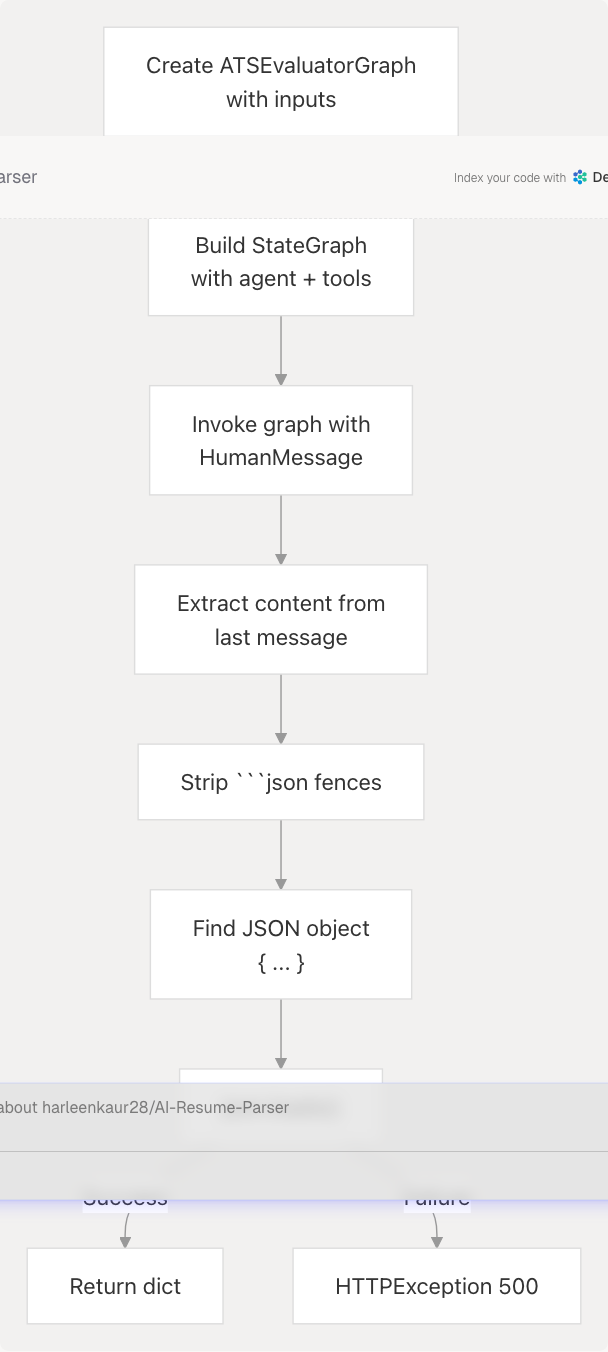
Sources: backend/app/services/ats_evaluator/graph.py122-207
JSON Parsing Logic
The function handles multiple output formats:
- Code Fence Removal - Strips
json` andmarkers using regex - JSON Extraction - Locates first
{and last}to isolate JSON object - Fallback Parsing - If initial parse fails, attempts to parse substring between braces
- Error Handling - Raises
HTTPExceptionwith status 500 if JSON is unparseable
# Strip code fences
code_fence_pattern = re.compile(r"^```(json)?\n", re.IGNORECASE)
content_str = code_fence_pattern.sub("", content_str)
if content_str.endswith("```"):
    content_str = content_str[:content_str.rfind("```")]

# Find and parse JSON
if content_str.startswith("{"):
    json_obj = json.loads(content_str)
else:
    start = content_str.find("{")
    end = content_str.rfind("}")
    json_obj = json.loads(content_str[start:end+1])
Sources: backend/app/services/ats_evaluator/graph.py153-204
Integration with Other Services
Used By Tailored Resume Service
The Tailored Resume Service (backend/app/services/tailored_resume.py) calls ats_evaluate_service() to get ATS feedback before generating optimized resumes:
ats_result = await ats_evaluate_service(
    resume_text=resume,
    jd_text=jd,
    jd_link=None,
    company_name=company_name,
    company_website=company_website,
)
The ATS score and suggestions are then passed to the resume generation prompt to guide improvements.
Sources: backend/app/services/resume_generator/graph.py87-113
Used By Resume Pipeline
The run_resume_pipeline() function in backend/app/services/resume_generator/graph.py72-235 integrates ATS evaluation into the tailored resume workflow:
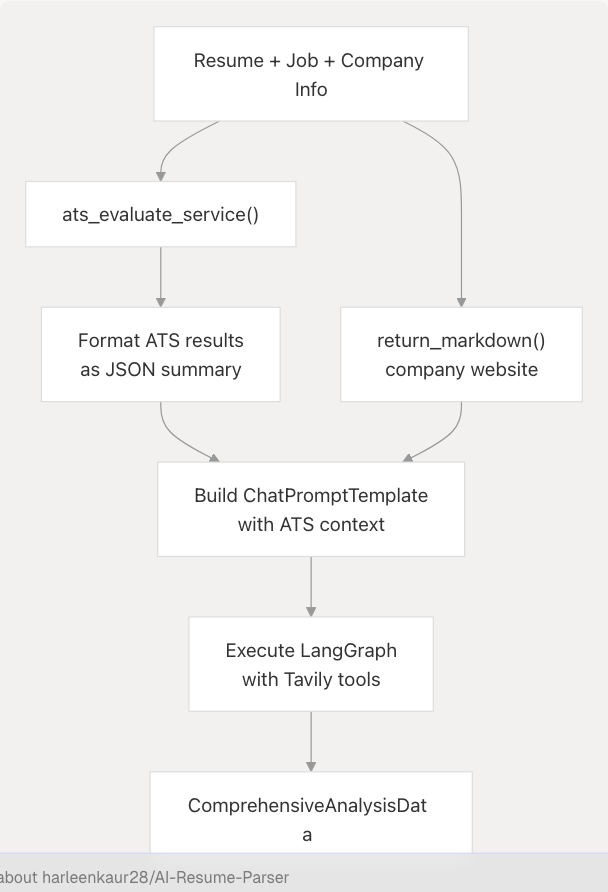
Sources: backend/app/services/resume_generator/graph.py86-149
Request/Response Flow
Full End-to-End Flow
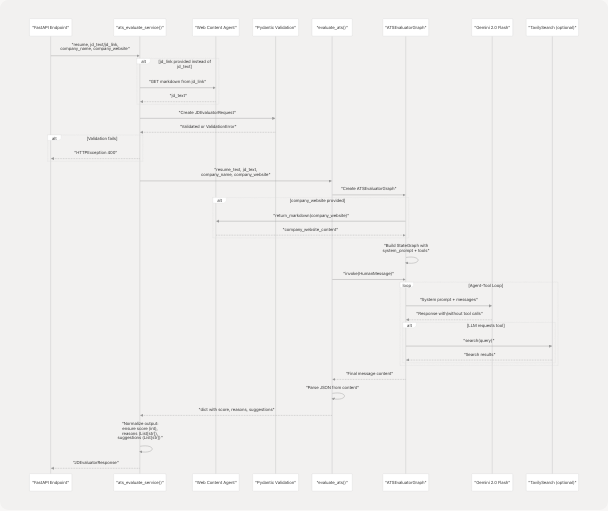
Sources: backend/app/services/ats.py24-113 backend/app/services/ats_evaluator/graph.py122-207
Error Handling and Normalization
Service Layer Error Handling
The service implements comprehensive error handling at multiple levels:
JD Retrieval Errors
try:
    jd_text = web_agent.return_markdown(jd_link)
except Exception as retrieval_error:
    logger.exception("Failed to fetch job description from link")
    raise HTTPException(
        status_code=500,
        detail="Failed to retrieve job description from link.",
    )
Sources: backend/app/services/ats.py46-60
Validation Errors
try:
    JDEvaluatorRequest(
        company_name=company_name,
        company_website_content=company_website,
        jd=jd_text,
        resume=resume_text,
    )
except ValidationError as ve:
    logger.warning("ATS evaluation validation error")
    raise HTTPException(status_code=400, detail=str(ve))
Sources: backend/app/services/ats.py78-97
Output Normalization
The service normalizes the raw evaluator output to ensure JDEvaluatorResponse compliance:
| Field | Normalization Logic |
|---|---|
success |
bool(analysis_json.get("success", True)) |
message |
analysis_json.get("message", "") or "" - ensures non-None string |
score |
int(analysis_json.get("score", 0)) with exception handling → defaults to 0 |
reasons_for_the_score |
Ensures List[str] - converts single values to list, stringifies all items |
suggestions |
Ensures List[str] - converts single values to list, stringifies all items |
try:
    score = int(analysis_json.get("score", 0))
except Exception:
    score = 0

raw_reasons = analysis_json.get("reasons_for_the_score", []) or []
if isinstance(raw_reasons, list):
    reasons_for_the_score = [str(r) for r in raw_reasons]
else:
    reasons_for_the_score = [str(raw_reasons)]
Sources: backend/app/services/ats.py142-180
Logging
The service includes structured logging at key checkpoints:
- Entry:
logger.debug("Starting ATS evaluation")with company name and JD source flags - Invocation:
logger.debug("Invoking ATS evaluator graph") - Raw Output:
logger.debug("ATS evaluator raw output")with output type - Normalized Payload:
logger.debug("ATS evaluator normalized payload")with all response fields - Completion:
logger.debug("ATS evaluation completed")with final score and success flag - Errors:
logger.exception()for retrieval failures, validation errors, and general exceptions
Sources: backend/app/services/ats.py33-40 backend/app/services/ats.py100-189
Configuration
Required Environment Variables
| Variable | Purpose | Used By |
|---|---|---|
GOOGLE_API_KEY |
Google Generative AI authentication | ChatGoogleGenerativeAI LLM initialization |
TAVILY_API_KEY |
Tavily Search API (optional) | TavilySearch tool for web research |
Model Configuration
The ATS evaluator uses GraphConfig dataclass with defaults:
@dataclass
class GraphConfig:
    model: str = MODEL_NAME  # "gemini-2.0-flash-exp" from app.core.llm
    temperature: float = 0.1
Low temperature (0.1) ensures deterministic, factual outputs suitable for scoring.
Sources: backend/app/services/ats_evaluator/graph.py42-46 backend/app/core/llm.py
Usage Example
Typical Service Call
from app.services.ats import ats_evaluate_service

result = await ats_evaluate_service(
    resume_text="John Doe\nSoftware Engineer...",
    jd_text="We are seeking a Senior Python Developer...",
    company_name="Acme Corp",
    company_website="https://acme.example.com"
)

print(f"ATS Score: {result.score}/100")
print(f"Reasons: {result.reasons_for_the_score}")
print(f"Suggestions: {result.suggestions}")
Alternative with JD Link
result = await ats_evaluate_service(
    resume_text=resume,
    jd_text=None,  # Not provided
    jd_link="https://jobs.example.com/posting/12345",
    company_name="Example Inc",
    company_website=None
)
The service automatically fetches the JD content from the link using the web content agent.
Sources: backend/app/services/ats.py24-30