API Documentation
This page provides comprehensive reference documentation for all backend API endpoints exposed by the TalentSync FastAPI server. It covers request/response formats, endpoint paths, HTTP methods, and Pydantic validation models. For information about the underlying AI services and processing logic, see Backend Services. For deployment configuration, see Deployment & Infrastructure.
API Architecture Overview
The TalentSync API is organized as a FastAPI application with modular routers. The main application is defined in backend/app/main.py, which includes multiple feature-specific routers under the /api/v1 and /api/v2 prefixes.
Router Organization

API Design Pattern: The API provides two versions for most endpoints:
- v1: File-based endpoints that accept
multipart/form-datawith resume file uploads - v2: Text-based endpoints that accept JSON payloads with resume text directly
Base Configuration
FastAPI Application Setup
The main FastAPI application is configured with the following parameters:
app = FastAPI(
    title="TalentSync Normies API",
    description="API for analyzing resumes, extracting structured data, and providing tips for improvement.",
    version="1.5.8",
)
CORS Configuration
All origins are allowed to facilitate frontend integration during development:
app.add_middleware(
    CORSMiddleware,
    allow_origins=["*"],
    allow_credentials=True,
    allow_methods=["*"],
    allow_headers=["*"],
)
Resume Analysis Endpoints
File-Based Resume Analysis (v1)
Endpoint: POST /api/v1/analyze_resume
Content-Type: multipart/form-data
Router: resume_file_based_router
Request Parameters:
file(UploadFile, required): Resume file (PDF, DOCX, TXT, or MD)- Additional form fields as needed
Response Model: ComprehensiveAnalysisResponse
Processing Flow:
- File text extraction via
process_document()function - Text cleaning and NLP preprocessing with spaCy
- TF-IDF vectorization and ML classification (predicts job category)
- LLM-powered comprehensive analysis using
comprehensive_analysis_prompt_v2 - Structured data extraction (skills, experience, projects, education)
Text-Based Resume Analysis (v2)
Endpoint: POST /api/v2/analyze_resume_text
Content-Type: application/json
Router: resume_text_based_router
Request Model: JSON payload with:
resume_text(string, required): Plain text of resume
Response Model: FormattedAndAnalyzedResumeResponse
Response Structure:
{
    "success": bool,
    "message": str,
    "cleaned_text": str,
    "analysis": {
        "name": str,
        "email": str,
        "contact": str,
        "predicted_field": str,
        "skills_analysis": [
            {
                "skill_name": str,
                "percentage": int  # 0-100
            }
        ],
        "recommended_roles": [str],
        "languages": [{"language": str}],
        "education": [{"education_detail": str}],
        "work_experience": [
            {
                "role": str,
                "company_and_duration": str,
                "bullet_points": [str]
            }
        ],
        "projects": [
            {
                "title": str,
                "technologies_used": [str],
                "description": str
            }
        ]
    }
}
ATS Evaluation Endpoints
ATS Score Mapping to Code
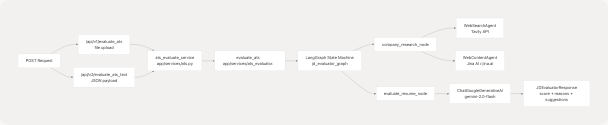
File-Based ATS Evaluation (v1)
Endpoint: POST /api/v1/evaluate_ats
Content-Type: multipart/form-data
Request Parameters:
file(UploadFile, required): Resume filejd_text(string, optional): Job description textjd_link(string, optional): Job description URLcompany_name(string, optional): Company name for researchcompany_website(string, optional): Company website for context
Note: Either jd_text or jd_link must be provided.
Text-Based ATS Evaluation (v2)
Endpoint: POST /api/v2/evaluate_ats_text
Content-Type: application/json
Request Model: JDEvaluatorRequest
{
    "company_name": str,  # optional
    "company_website_content": str,  # optional
    "jd": str,  # required, min_length=1
    "jd_link": str,  # optional
    "resume": str  # required, min_length=1
}
Response Model: JDEvaluatorResponse
{
    "success": bool,
    "message": str,
    "score": int,  # 0-100
    "reasons_for_the_score": [str],
    "suggestions": [str]
}
Processing Details:
- If
jd_linkprovided but nojd_text, fetches JD content viaWebContentAgent - Uses LangGraph state machine for multi-step workflow
- Optionally performs web research on company via
Tavilysearch API - Generates structured evaluation using Gemini 2.0 Flash LLM
Cold Mail Generator Endpoints
Request/Response Flow
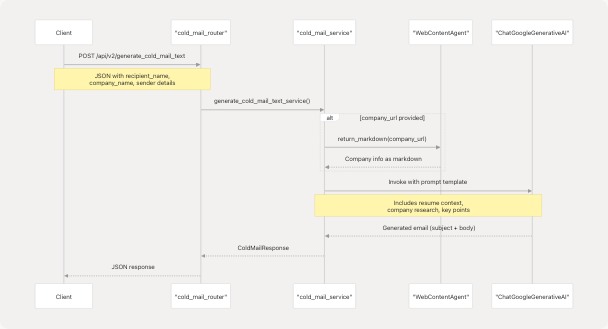
File-Based Cold Mail (v1)
Endpoint: POST /api/v1/generate_cold_mail
Content-Type: multipart/form-data
Request Parameters:
file(UploadFile, required): Resume filerecipient_name(string, required)recipient_designation(string, required)company_name(string, required)sender_name(string, required)sender_role_or_goal(string, required)key_points_to_include(string, required, min_length=10)additional_info_for_llm(string, optional)company_url(string, optional)
Text-Based Cold Mail (v2)
Endpoint: POST /api/v2/generate_cold_mail_text
Content-Type: application/json
Request Model: ColdMailRequest (extends base with resume_text)
{
    "recipient_name": str,  # required
    "recipient_designation": str,  # required
    "company_name": str,  # required
    "sender_name": str,  # required
    "sender_role_or_goal": str,  # required
    "key_points_to_include": str,  # required, min 10 chars
    "additional_info_for_llm": str,  # optional
    "company_url": str,  # optional
    "resume_text": str  # required for v2
}
Response Model: ColdMailResponse
{
    "success": bool,
    "message": str,
    "subject": str,
    "body": str
}
Features:
- Automatic company research if
company_urlprovided (via Jina AI r.jina.ai) - Personalized email generation based on resume analysis
- Professional tone optimization
- Company-specific context integration
Hiring Assistant Endpoints
File-Based Hiring Assistant (v1)
Endpoint: POST /api/v1/answer_questions
Content-Type: multipart/form-data
Request Parameters:
file(UploadFile, required): Resume filerole(string, required, min_length=1)questions(List[str], optional): Interview questionscompany_name(string, required, min_length=1)user_knowledge(string, optional): User's existing knowledgecompany_url(string, optional): Company URL for researchword_limit(int, optional, default=150, range: 50-500)
Text-Based Hiring Assistant (v2)
Endpoint: POST /api/v2/answer_questions_text
Content-Type: application/json
Request Model: HiringAssistantRequest (extends base with resume_text)
{
    "role": str,  # required
    "questions": [str],  # optional list
    "company_name": str,  # required
    "user_knowledge": str,  # optional
    "company_url": str,  # optional
    "word_limit": int,  # 50-500, default 150
    "resume_text": str  # required for v2
}
Response Model: HiringAssistantResponse
{
    "success": bool,
    "message": str,
    "data": {
        "question_1": str,
        "question_2": str,
        // ... one answer per question
    }
}
Question Generation: If no questions provided, default set includes:
- "Why do you want to work here?"
- "What are your strengths?"
- "Tell me about yourself"
Processing Features:
- Web research on company via
WebSearchAgent(Tavily) - Resume context integration
- Word-limited, role-specific answers
- STAR method formatting when appropriate
Tailored Resume Endpoints
File-Based Tailored Resume (v1)
Endpoint: POST /api/v1/generate_tailored_resume
Content-Type: multipart/form-data
Request Parameters:
file(UploadFile, required): Resume filejob(string, required): Target job rolecompany_name(string, optional)company_website(string, optional)job_description(string, optional)
Text-Based Tailored Resume (v2)
Endpoint: POST /api/v2/generate_tailored_resume_text
Content-Type: application/json
Request Model: TailoredResumeRequest
{
    "resume_text": str,  # required
    "job": str,  # required
    "company_name": str,  # optional
    "company_website": str,  # optional
    "job_description": str  # optional
}
Response Model: ComprehensiveAnalysisResponse
LangGraph Workflow:
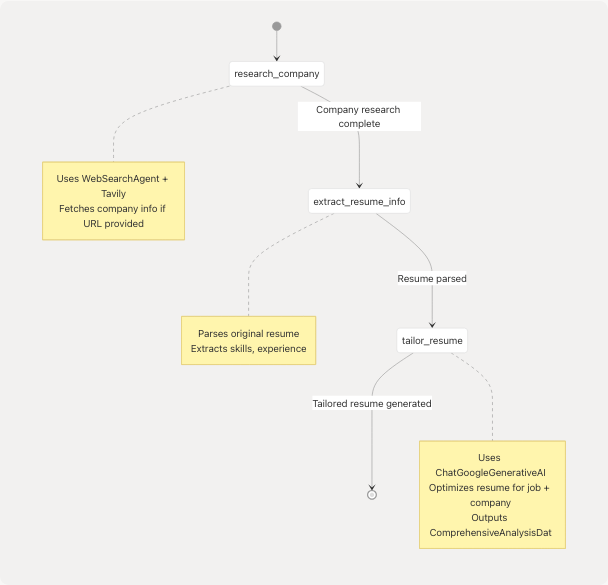
Features:
- Job-specific optimization
- Company research integration via web search
- Keyword alignment with job description
- Maintains original achievements while reframing
LinkedIn Services Endpoints
LinkedIn Post Generation
Endpoint: POST /api/v1/linkedin/generate-posts
Content-Type: application/json
Request Model: PostGenerationRequest
{
    "topic": str,  # required
    "tone": str,  # optional
    "audience": [str],  # optional
    "length": "Short" | "Medium" | "Long" | "Any",  # default: "Medium"
    "hashtags_option": str,  # default: "suggest"
    "cta_text": str,  # optional
    "mimic_examples": str,  # optional
    "language": str,  # optional
    "post_count": int,  # 1-5, default: 3
    "emoji_level": int,  # 0-3, default: 1
    "github_project_url": HttpUrl,  # optional
    "enable_research": bool  # default: true
}
Response Model: PostGenerationResponse
{
    "success": bool,
    "message": str,
    "posts": [
        {
            "text": str,
            "hashtags": [str],
            "cta_suggestion": str,
            "token_info": {},
            "sources": [
                {
                    "title": str,
                    "link": str
                }
            ],
            "github_project_name": str  # if GitHub URL provided
        }
    ],
    "timestamp": str
}
Optional Features:
- GitHub project analysis via
GitHubAgent(usesgitingestlibrary) - Web research via
WebSearchAgent(Tavily) - Multi-post generation with varied angles
- Automatic hashtag suggestions
GitHub Project Analysis
Endpoint: POST /api/v1/linkedin/analyze-github
Content-Type: application/json
Request Model: GitHubAnalysisRequest
{
    "github_url": HttpUrl  # required
}
Response Model: GitHubAnalysisResponse
{
    "success": bool,
    "repository_info": {
        "name": str,
        "description": str,
        "stars": int,
        "language": str,
        "topics": [str],
        // ... more GitHub metadata
    },
    "linkedin_insights": {
        "key_achievement": str,
        "technical_highlights": str,
        "impact_statement": str,
        "linkedin_hooks": [str],
        "suggested_hashtags": [str],
        "project_stats": {}
    },
    "timestamp": str
}
Data Sources:
- GitHub REST API v3 (public repository data)
gitingestlibrary for deep repository analysis (optional)- LLM analysis for LinkedIn-specific insights
Tips Generator Endpoint
Endpoint: POST /api/v1/tips
Content-Type: application/json
Request Parameters (JSON):
job_category(string, optional): Job field/categoryskills_list(List[str], optional): User's key skills
Response Model: TipsResponse
{
    "success": bool,
    "message": str,
    "data": {
        "resume_tips": [
            {
                "category": str,  # e.g., "Content", "Keywords"
                "advice": str
            }
        ],
        "interview_tips": [
            {
                "category": str,  # e.g., "Preparation", "Answering Questions"
                "advice": str
            }
        ]
    }
}
Tip Categories:
- Resume: Content, Formatting, Keywords, Impact, Tailoring
- Interview: Preparation, Behavioral Questions, STAR Method, Follow-up
Prompt Template: Uses tips_generator_prompt with job category and skills context.
Database Operations Endpoints
Get All Resumes
Endpoint: GET /api/v1/resumes
Query Parameters: None
Response Model: ResumeListResponse
{
    "success": bool,
    "message": str,
    "data": [
        {
            "name": str,
            "email": str,
            "predicted_field": str,
            "skills": [str],
            // ... full ResumeAnalysis object
        }
    ],
    "count": int
}
Get Resume by ID
Endpoint: GET /api/v1/resumes/{resume_id}
Path Parameters:
resume_id(integer, required)
Response: Single ResumeAnalysis object or 404 if not found.
Get Resumes by Category
Endpoint: GET /api/v1/resumes/category/{category}
Path Parameters:
category(string, required): Job category/field
Response Model: ResumeCategoryResponse
{
    "success": bool,
    "message": str,
    "data": [ResumeAnalysis],
    "count": int,
    "category": str
}
Pydantic Request/Response Models
Core Data Models Summary Table
| Model | Purpose | Key Fields | Source |
|---|---|---|---|
ComprehensiveAnalysisData |
Full resume analysis structure | skills_analysis, work_experience, projects, education | schemas.py114-135 |
JDEvaluatorRequest |
ATS evaluation input | company_name, jd, resume | schemas.py475-486 |
JDEvaluatorResponse |
ATS evaluation output | score, reasons_for_the_score, suggestions | schemas.py488-499 |
ColdMailRequest |
Cold email generation input | recipient_name, company_name, key_points_to_include | schemas.py241-280 |
ColdMailResponse |
Cold email output | subject, body | schemas.py282-287 |
HiringAssistantRequest |
Interview prep input | role, questions, company_name | schemas.py204-233 |
HiringAssistantResponse |
Interview prep output | data (question -> answer mapping) | schemas.py235-239 |
PostGenerationRequest |
LinkedIn post input | topic, tone, post_count, github_project_url | schemas.py360-375 |
PostGenerationResponse |
LinkedIn post output | posts[], timestamp | schemas.py398-403 |
Nested Model: SkillProficiency
Used in ComprehensiveAnalysisData.skills_analysis:
{
    "skill_name": str,  # e.g., "Python"
    "percentage": int   # 0-100, proficiency level
}
Nested Model: UIDetailedWorkExperienceEntry
Used in ComprehensiveAnalysisData.work_experience:
{
    "role": str,
    "company_and_duration": str,  # e.g., "Google | 2020 - Present"
    "bullet_points": [str]  # list of achievements
}
Nested Model: UIProjectEntry
Used in ComprehensiveAnalysisData.projects:
{
    "title": str,
    "technologies_used": [str],
    "live_link": str,  # optional
    "repo_link": str,  # optional
    "description": str
}
Error Handling
Standard Error Response
All endpoints return errors in a consistent format:
{
    "detail": str  # Error message
}
HTTP Status Codes:
400: Bad Request (validation errors, missing required fields)404: Not Found (resource doesn't exist)500: Internal Server Error (processing failures, LLM errors)
Common Error Scenarios
| Error Type | Status Code | Example |
|---|---|---|
| Missing required field | 400 | "detail": "Field required" |
| Invalid file format | 400 | "detail": "Unsupported file type" |
| LLM API failure | 500 | "detail": "ATS evaluation failed: API timeout" |
| Resume not found | 404 | "detail": "Resume with ID 123 not found" |
Validation Errors: FastAPI automatically validates requests using Pydantic models and returns 422 Unprocessable Entity with detailed field-level errors.
ML Model Integration Details
TF-IDF Classifier Pipeline

Model Files:
backend/app/model/best_model.pkl: Pre-trained scikit-learn classifierbackend/app/model/tfidf.pkl: TF-IDF vectorizer fitted on training databackend/app/model/nltk_data/: NLTK corpus data (stopwords, punkt)
Job Categories: The classifier predicts one of 25 job categories including "Java Developer", "Data Science", "HR", "Mechanical Engineer", etc.
LLM Configuration
Google Gemini Integration
Model: gemini-2.0-flash (default) or gemini-2.0-flash-lite
Framework: LangChain (langchain-google-genai)
Temperature: 0.1 (low randomness for consistency)
Initialization:
from langchain_google_genai import ChatGoogleGenerativeAI

llm = ChatGoogleGenerativeAI(
    model="gemini-2.0-flash",
    google_api_key=os.getenv("GOOGLE_API_KEY"),
    temperature=0.1,
)
Environment Variable: GOOGLE_API_KEY must be set in .env file.
External Service Dependencies
Tavily Search API
Usage: Web research for company information, industry trends
Environment Variable: TAVILY_API_KEY
Integration: Via langchain-tavily package
Endpoints Using Tavily:
- ATS Evaluation (company research)
- Hiring Assistant (company research)
- LinkedIn Post Generation (topic research)
Jina AI Web Content Extraction
Usage: Convert URLs to clean markdown text
API Endpoint: https://r.jina.ai/{url}
No Auth Required: Public API
Use Cases:
- Job description extraction from URLs
- Company website content scraping
- CORS bypass for content access
Implementation:
def return_markdown(url: str) -> str:
    response = requests.get(
        f"https://r.jina.ai/{url}",
        headers={"X-Return-Format": "markdown"}
    )
    return response.text
API Versioning Strategy
v1 (File Upload Endpoints)
- Accept
multipart/form-data - Require file upload for resume
- Extract text server-side using PyPDF2, python-docx
- Suitable for direct user uploads from frontend
v2 (Text-Based Endpoints)
- Accept
application/json - Require resume text as string field
- No file processing overhead
- Suitable for integrations where text is already extracted
Recommendation: Use v2 for better performance if resume text is already available. Use v1 for traditional file upload UX.
OpenAPI/Swagger Documentation
FastAPI automatically generates interactive API documentation:
- Swagger UI: Available at
/docswhen server is running - ReDoc: Available at
/redocwhen server is running - OpenAPI JSON Schema: Available at
/openapi.json
The auto-generated documentation includes:
- All endpoint paths and methods
- Request/response schemas with examples
- Validation rules and constraints
- Interactive "Try it out" functionality