Web Search Agent
Purpose and Scope
The Web Search Agent provides intelligent web search capabilities using the Tavily Search API. It enables AI services to gather real-time information about companies, job roles, industry trends, and other topics by searching the web and extracting clean content. This agent is used primarily by the ATS Evaluator (3.2), Tailored Resume Service (3.5), and LinkedIn Services (3.6) to enrich their outputs with current information.
For web content extraction from specific URLs, see the Web Content Agent (3.7.3). For GitHub repository analysis, see the GitHub Agent (3.7.1).
Sources: backend/app/agents/websearch_agent.py1-271
Architecture Overview
The Web Search Agent implements a two-stage pipeline: search and content extraction. It uses the Tavily API for high-quality web search results, then leverages the Web Content Agent to extract clean markdown content from the discovered URLs.
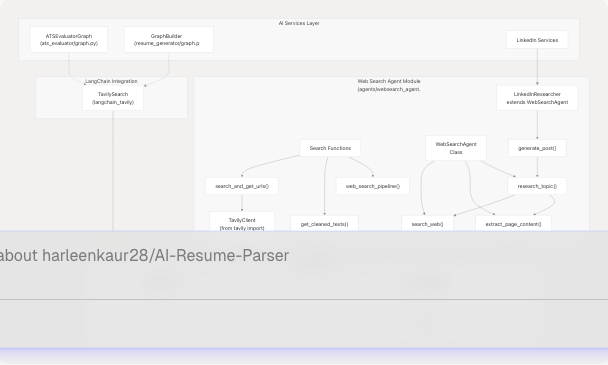
Sources: backend/app/agents/websearch_agent.py1-271 backend/app/services/ats_evaluator/graph.py27-40 backend/app/services/resume_generator/graph.py151-153
Core Components
Tavily Client Integration
The agent initializes a TavilyClient instance when the TAVILY_API_KEY environment variable is present. The client is stored as a module-level singleton to avoid repeated initialization.
| Component | Type | Purpose |
|---|---|---|
_TAVILY_API_KEY |
str |
Environment variable storing the Tavily API key |
_tavily |
Optional[TavilyClient] |
Singleton client instance, None if key is missing |
search_and_get_urls() |
Function | Performs web search and returns URLs |
Configuration:
max_results: Number of search results to return (default 10)search_depth: "advanced" or "basic" (controls search quality vs speed)include_answer: Set toFalse(we extract our own content)include_raw_content: Set toFalse(we use Jina AI instead)
Sources: backend/app/agents/websearch_agent.py63-96
WebSearchAgent Class
The WebSearchAgent class provides an object-oriented interface for web searching with LLM-powered summarization.
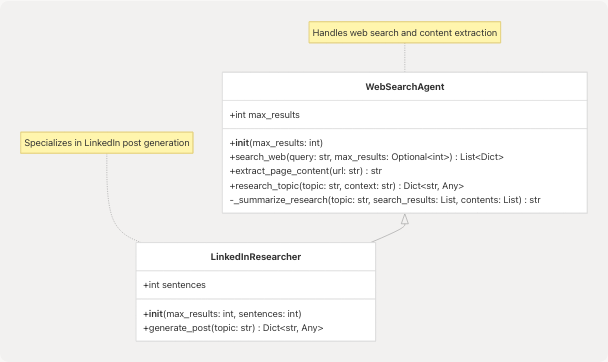
Key Methods:
| Method | Returns | Purpose |
|---|---|---|
search_web() |
List[Dict[str, str]] |
Returns list of URLs with metadata |
extract_page_content() |
str |
Extracts markdown content from a single URL |
research_topic() |
Dict[str, Any] |
Searches, extracts content, and generates summary |
_summarize_research() |
str |
Uses LLM to summarize research findings |
Sources: backend/app/agents/websearch_agent.py129-203
LinkedInResearcher Class
The LinkedInResearcher extends WebSearchAgent to specialize in generating LinkedIn posts from research topics.
Additional Configuration:
sentences: Maximum number of sentences for the LinkedIn post (default 3)
Key Method:
generate_post(topic: str): Researches a topic and generates a professional LinkedIn post with hooks and minimal hashtags
Sources: backend/app/agents/websearch_agent.py205-236
Search Pipeline
The web search pipeline follows a multi-stage process from query to cleaned content.
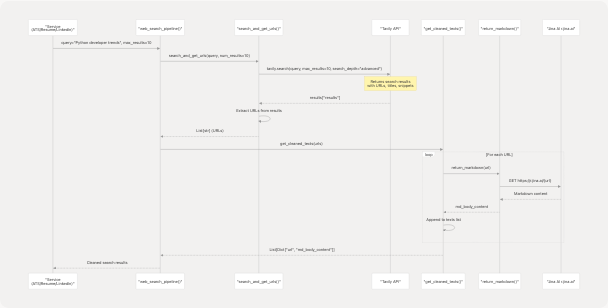
Pipeline Stages:
-
Search Stage (
search_and_get_urls):- Sends query to Tavily API
- Extracts URLs from results
- Limits to requested number of results
-
Content Extraction Stage (
get_cleaned_texts):- Iterates through URLs
- Fetches markdown content via Jina AI
- Filters out empty results
- Returns structured data with URL and content
Sources: backend/app/agents/websearch_agent.py69-122
LangChain Integration
The Web Search Agent is integrated into LangChain/LangGraph workflows through the TavilySearch tool from the langchain_tavily package.
TavilySearch Tool Configuration
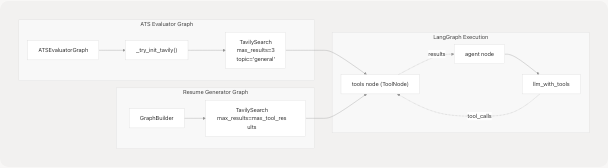
ATS Evaluator Usage: backend/app/services/ats_evaluator/graph.py27-40
- Tool initialized in
_try_init_tavily()helper function - Returns empty list if import fails
- Bound to LLM in
ATSEvaluatorGraph.__init__ - Maximum 3 results per search
Resume Generator Usage: backend/app/services/resume_generator/graph.py151-153
- Tool created directly in
run_resume_pipeline() - Configurable via
max_tool_resultsparameter - Integrated into
GraphBuilderwith system prompts
Sources: backend/app/services/ats_evaluator/graph.py27-40 backend/app/services/resume_generator/graph.py151-165
Error Handling and Resilience
The Web Search Agent implements multiple layers of error handling to ensure graceful degradation.
Retry Logic
| Parameter | Value | Purpose |
|---|---|---|
REQUEST_TIMEOUT |
15 seconds | Maximum time for HTTP requests |
MAX_RETRIES |
2 | Number of retry attempts |
BACKOFF_BASE |
0.7 | Base delay for exponential backoff |
Retry Strategy:
- Retries on transient HTTP errors (429, 500, 502, 503, 504)
- Exponential backoff:
BACKOFF_BASE * (2^attempt) - Random user agent rotation to avoid rate limiting
Sources: backend/app/agents/websearch_agent.py21-59
Graceful Degradation
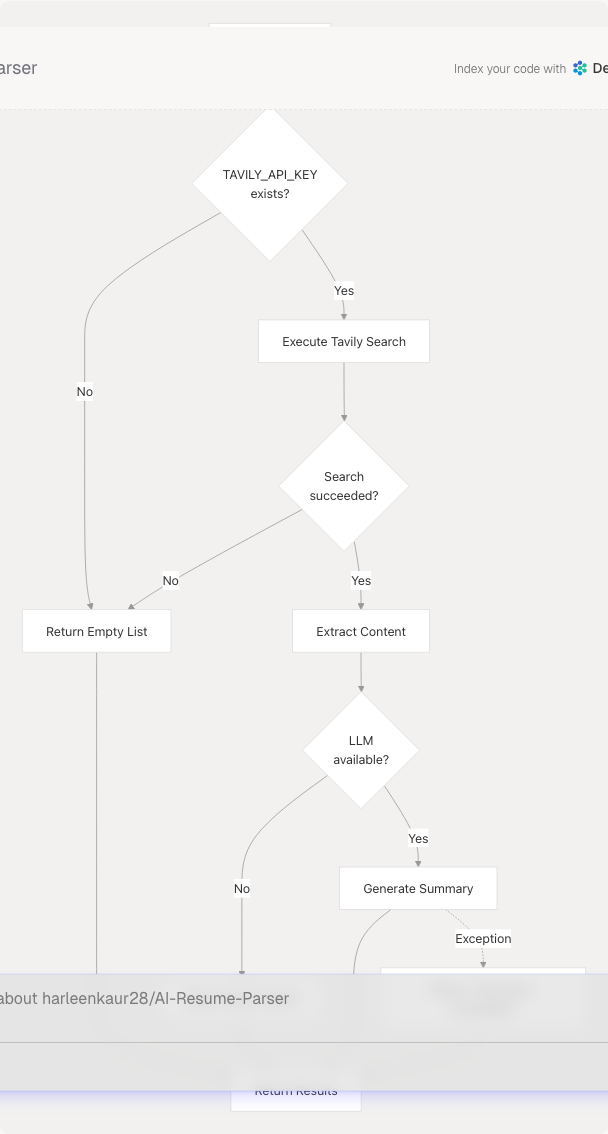
Fallback Behaviors:
- Missing API key: Returns empty list, logs warning
- Search failure: Returns empty list, logs exception
- LLM unavailable: Returns raw content without summarization
- Summarization failure: Returns fallback message
Sources: backend/app/agents/websearch_agent.py72-96 backend/app/agents/websearch_agent.py171-202
Usage Patterns
Direct Function Usage
For simple search and content extraction without classes:
# Example usage (not actual code, for illustration)
results = web_search_pipeline(
    query="Python developer salary 2024",
    max_results=5
)
# Returns: [{"url": "...", "md_body_content": "..."}]
Sources: backend/app/agents/websearch_agent.py113-122
Agent-Based Research
For research with LLM-powered summarization:
# Example usage (not actual code, for illustration)
agent = WebSearchAgent(max_results=10)
research = await agent.research_topic(
    topic="machine learning trends",
    context=""
)
# Returns: {
#     "search_results": [...],
#     "extracted_content": [...],
#     "research_summary": "..."
# }
Sources: backend/app/agents/websearch_agent.py150-169
LinkedIn Post Generation
For generating professional LinkedIn content:
# Example usage (not actual code, for illustration)
researcher = LinkedInResearcher(max_results=10, sentences=3)
post_data = await researcher.generate_post(topic="AI in healthcare")
# Returns: {
#     "search_results": [...],
#     "extracted_content": [...],
#     "research_summary": "...",
#     "linkedin_post": "..."
# }
Sources: backend/app/agents/websearch_agent.py210-235
Configuration
Environment Variables
| Variable | Required | Purpose |
|---|---|---|
TAVILY_API_KEY |
Yes | API key for Tavily Search service |
Sources: backend/app/agents/websearch_agent.py63-66
User Agent Rotation
The agent rotates through multiple user agent strings to avoid detection and rate limiting:
- Windows Chrome 124
- macOS Safari 16.4
- Linux Chrome 124
Sources: backend/app/agents/websearch_agent.py25-35
Search Parameters
Tavily Search Configuration:
search_depth: "advanced" (higher quality) vs "basic" (faster)include_answer:False(we generate our own summaries)include_raw_content:False(we use Jina AI for cleaner extraction)include_images:False(text-only focus)
Sources: backend/app/agents/websearch_agent.py76-84
Integration Points
Services Using Web Search Agent
| Service | Integration Method | Purpose |
|---|---|---|
| ATS Evaluator | TavilySearch tool via LangGraph |
Research companies and job market trends |
| Tailored Resume | TavilySearch tool via LangGraph |
Gather company information and tech stack details |
| LinkedIn Services | LinkedInResearcher class |
Generate research-backed LinkedIn posts |
Sources: backend/app/services/ats_evaluator/graph.py27-40 backend/app/services/resume_generator/graph.py151-153
Dependencies
The Web Search Agent depends on:
- Web Content Agent: For extracting markdown from URLs (3.7.3)
- LLM Core: For summarizing research findings (3.8)
- Tavily API: External search service
- Jina AI: External content extraction service (via Web Content Agent)
Sources: backend/app/agents/websearch_agent.py13 backend/app/agents/websearch_agent.py125