Backend Services
Purpose and Scope
This document provides a comprehensive overview of the backend services powering TalentSync, an AI-driven hiring intelligence platform. The backend is built on FastAPI and provides RESTful APIs for resume analysis, ATS evaluation, cold email generation, interview preparation, and LinkedIn content creation.
For information about the overall system architecture, see System Architecture. For details on individual AI service implementations, see subsections Resume Analysis Service, ATS Evaluation Service, Cold Mail Generator Service, Hiring Assistant Service, Tailored Resume Service, and LinkedIn Services. For frontend integration patterns, see Frontend Application. For deployment infrastructure, see Deployment & Infrastructure.
Backend Architecture Overview
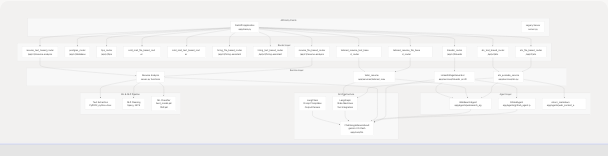
The TalentSync backend follows a modular service-oriented architecture with clear separation of concerns. Services are organized into routers, each handling specific feature domains with both file-based (v1) and text-based (v2) API endpoints.
Service Organization Diagram
API Versioning Strategy
TalentSync implements a dual-version API strategy to support both legacy file upload workflows (v1) and modern text-based workflows (v2). This approach allows gradual migration while maintaining backward compatibility.
| Feature | v1 Endpoint | v2 Endpoint | Input Type |
|---|---|---|---|
| Cold Mail Generation | /api/v1/cold-mail |
/api/v2/cold-mail |
v1: File upload, v2: Text/JSON |
| Hiring Assistant | /api/v1/hiring-assistant |
/api/v2/hiring-assistant |
v1: File upload, v2: Text/JSON |
| Resume Analysis | /api/v1/resume-analysis |
/api/v2/resume-analysis |
v1: File upload, v2: Text/JSON |
| ATS Evaluation | /api/v1/ats |
/api/v2/ats |
v1: File upload, v2: Text/JSON |
| Tailored Resume | /api/v1/tailored-resume |
/api/v2/tailored-resume |
v1: File upload, v2: Text/JSON |
Version Routing Implementation:
- v1 routers registered at
/api/v1prefix - v2 routers registered at
/api/v2prefix - Cold mail v2 router duplicated at both
/api/v1and/api/v2for migration support
Service Dependency Graph
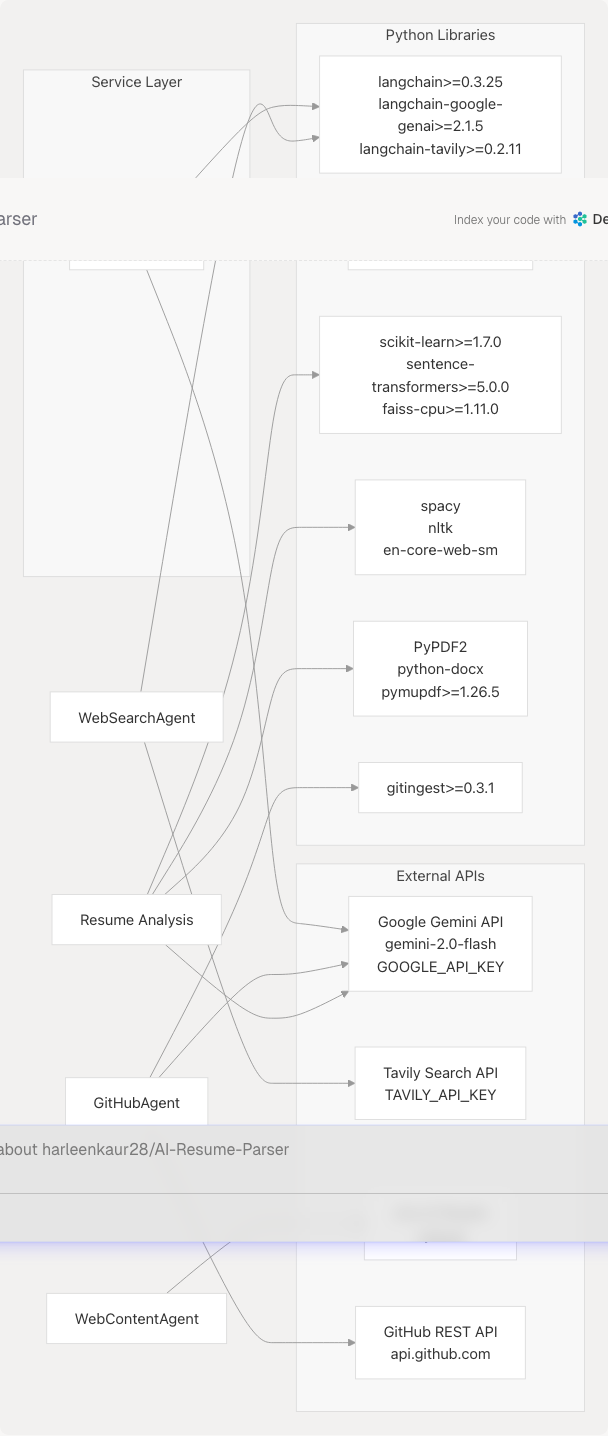
Core Services Overview
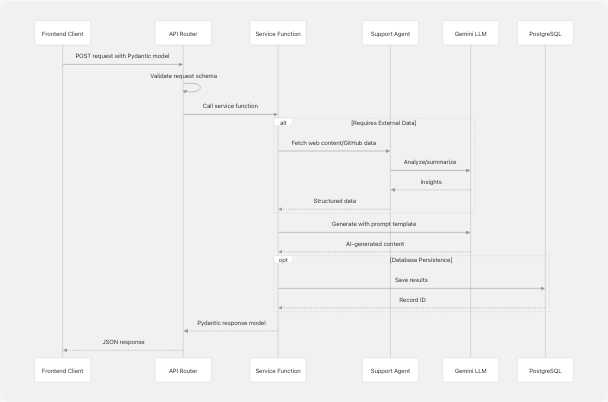
Request/Response Flow Pattern
All TalentSync services follow a consistent request/response pattern using Pydantic models for validation and structured data exchange.
Data Models Architecture
Schema Organization
TalentSync uses Pydantic models extensively for request validation, response serialization, and data structure enforcement. Models are organized by feature domain in app/models/schemas.py.
Key Model Categories:
| Category | Models | Purpose |
|---|---|---|
| Resume Analysis | ComprehensiveAnalysisData, ComprehensiveAnalysisResponse, ResumeAnalysis |
Structure resume parsing results with skills, experience, projects |
| ATS Evaluation | JDEvaluatorRequest, JDEvaluatorResponse |
Job description matching with score and suggestions |
| Cold Mail | ColdMailRequest, ColdMailResponse |
Personalized email generation parameters |
| Hiring Assistant | HiringAssistantRequest, HiringAssistantResponse |
Interview Q&A generation |
PostGenerationRequest, GeneratedPost, LinkedInPageRequest |
Content creation with metadata | |
| Tailored Resume | TailoredResumeRequest, TailoredResumeResponse |
Job-specific resume optimization |
Nested Structures:
WorkExperienceEntryandUIDetailedWorkExperienceEntryfor work historyProjectEntryandUIProjectEntryfor project detailsSkillProficiencyfor skill assessment with percentageEducationEntry,LanguageEntry,CertificationEntryfor profile sections
Service Communication Patterns
Service-to-Agent Communication
Services orchestrate agent calls to enrich AI-generated content with real-time web data, company research, and GitHub project insights.
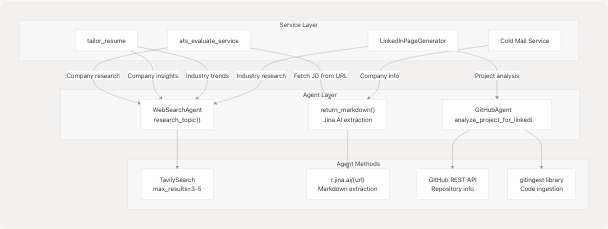
Agent Integration Examples:
ATS Service using Web Content Agent:
# Fetch job description from URL
if jd_link is not None:
    import app.agents.web_content_agent as web_agent
    jd_text = web_agent.return_markdown(jd_link)
backend/app/services/ats.py44-47
LinkedIn Service using GitHub Agent:
# Analyze GitHub projects
for repo_url in request.featured_repositories:
    analysis = await self.github_agent.analyze_project_for_linkedin(str(repo_url))
    if not analysis.get("error"):
        github_insights.append(analysis)
backend/app/services/linkedin_profile.py109-115
Request Processing Pipeline
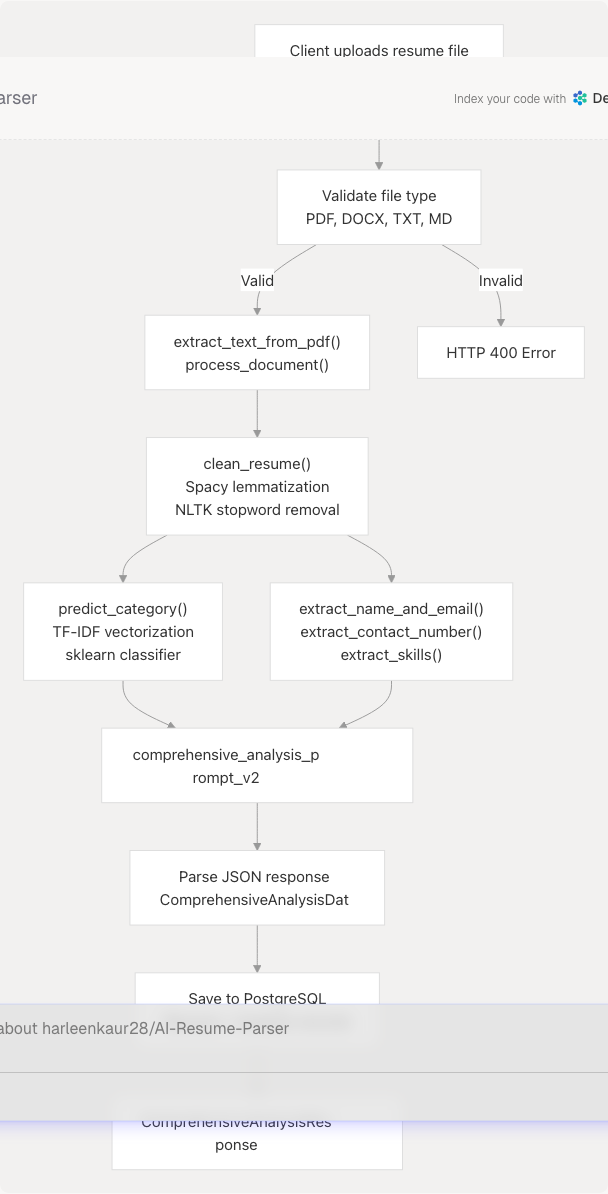
End-to-End Flow for Resume Analysis
Key Functions:
| Function | Location | Purpose |
|---|---|---|
process_document() |
server.py764-792 | Extract raw text from file bytes |
clean_resume() |
server.py738-749 | Remove URLs, punctuation, lemmatize tokens |
predict_category() |
Uses TF-IDF + classifier | Classify resume into 25 job categories |
extract_name_and_email() |
server.py923-932 | Regex-based contact extraction |
extract_skills_from_resume() |
Uses skills list | Match known skills from text |
comprehensive_analysis_prompt_v2 |
server.py373-453 | LLM prompt for structured extraction |
LLM Integration Architecture
Prompt Template System
TalentSync uses LangChain PromptTemplate objects to structure LLM interactions with consistent variable injection and output formatting.
Core Prompt Templates:
| Template | Location | Input Variables | Output Format |
|---|---|---|---|
comprehensive_analysis_prompt_v2 |
server.py373-453 | extracted_resume_text, basic_info_json |
JSON conforming to ComprehensiveAnalysisData |
tips_generator_prompt |
server.py497-500 | job_category, skills_list_str |
JSON with resume_tips and interview_tips |
format_analyse_prompt |
server.py595-601 | raw_resume_text, basic_info_json |
JSON with cleaned_text and analysis |
LLM Configuration:
llm = ChatGoogleGenerativeAI(
    model="gemini-2.0-flash",
    google_api_key=os.getenv("GOOGLE_API_KEY"),
    temperature=0.1,  # Low temperature for consistent, factual output
)
Temperature Strategy:
- 0.1: Used for structured data extraction (resume analysis, ATS scoring)
- Higher values: Used for creative content generation (LinkedIn posts)
Machine Learning Pipeline
Traditional ML + LLM Hybrid Approach
The resume analysis service combines traditional machine learning for fast job category classification with LLM-powered semantic understanding for detailed field extraction.

ML Model Details:
- Vectorizer: TF-IDF with tokenization and feature extraction
- Classifier: Pre-trained scikit-learn model (
best_model.pkl) - Categories: 25 job categories (e.g., "Java Developer", "Data Science", "HR", "Advocate")
- Purpose: Fast category prediction to guide LLM field inference
Model Loading:
clf = pickle.load(open(
    os.path.join(os.path.dirname(__file__), "app", "model", "best_model.pkl"),
    "rb",
))
tfidf_vectorizer = pickle.load(open(
    os.path.join(os.path.dirname(__file__), "app", "model", "tfidf.pkl"),
    "rb",
))
Database Integration
PostgreSQL Schema and Persistence
TalentSync uses PostgreSQL for persisting user data, resume analyses, and generated content. Database operations are handled via Prisma ORM on the frontend side, with backend services receiving pre-validated data.
Database Router (postgres_router at /api/v1/database):
- Handles database queries from frontend
- Returns resume lists, categories, and analysis details
- Manages cascading deletions for user account removal
Data Persistence Pattern:
- Backend service generates analysis/content
- Frontend receives response with generated data
- Frontend persists to PostgreSQL via Prisma
- Frontend displays cached data from database
Note: Backend services are stateless and do not directly manage database transactions. Database schema and management details are covered in Database & Data Models.
Error Handling and Validation
Service-Level Error Strategy
All services implement consistent error handling using FastAPI's HTTPException for client errors and structured error responses.
Error Response Pattern:
try:
    # Validate inputs
    JDEvaluatorRequest(
        company_name=company_name,
        company_website_content=company_website,
        jd=jd_text,
        resume=resume_text,
    )
except ValidationError as ve:
    raise HTTPException(status_code=400, detail=str(ve))

try:
    # Service logic
    result = await process_request()
    return StructuredResponse(**result)
except Exception as e:
    raise HTTPException(status_code=500, detail=f"Service failed: {e}")
HTTP Status Code Usage:
| Status Code | Use Case | Example |
|---|---|---|
| 400 | Bad Request - validation errors | Missing required fields, invalid URL format |
| 404 | Not Found | Resume not found in database |
| 500 | Internal Server Error | LLM timeout, API key invalid, service failure |
Validation Layers:
- Pydantic Model Validation: Automatic field type and constraint checking
- Service-Level Validation: Business logic validation (e.g.,
jd_textorjd_linkrequired) - External API Validation: Check for API availability and valid responses
CORS and Middleware Configuration
FastAPI Middleware Setup
Both the legacy server and modern main application configure CORS to allow cross-origin requests from any origin during development.
app.add_middleware(
    CORSMiddleware,
    allow_origins=["*"],  # Development: allow all origins
    allow_credentials=True,
    allow_methods=["*"],  # Allow all HTTP methods
    allow_headers=["*"],  # Allow all headers
)
Production Recommendation: Replace allow_origins=["*"] with specific frontend domain(s) for security.
Environment Configuration
Required Environment Variables
TalentSync backend requires several API keys for external service integration. These are loaded via python-dotenv from a .env file.
| Variable | Service | Required For |
|---|---|---|
GOOGLE_API_KEY |
Google Gemini API | All LLM-powered features |
TAVILY_API_KEY |
Tavily Search | Web research agents (optional) |
DATABASE_URL |
PostgreSQL | Database operations (frontend) |
Environment Loading:
from dotenv import load_dotenv
load_dotenv()

google_api_key = os.getenv("GOOGLE_API_KEY")
if not google_api_key:
    print("Warning: GOOGLE_API_KEY not found. LLM functionality will be disabled.")
Graceful Degradation:
- Missing
TAVILY_API_KEY: Web search features disabled, services continue without research enrichment - Missing
GOOGLE_API_KEY: LLM features disabled, services return error responses
Performance Considerations
Optimization Strategies
Async/Await Pattern:
- All services use
async/awaitfor non-blocking I/O operations - LLM calls:
await llm.ainvoke(prompt) - Agent calls:
await agent.research_topic(query)
Content Truncation:
- GitHub ingestion limited to ~1.8M characters to prevent memory issues
- README content truncated to 1000 characters
- LLM context windows managed with excerpts
Model Caching:
- ML models (
best_model.pkl,tfidf.pkl) loaded once at startup - NLTK data downloaded once to
backend/app/model/nltk_data/ - Spacy model (
en_core_web_sm) loaded globally
Timeout Management:
- HTTP requests timeout after 10 seconds
- GitHub ingestion timeout: 60 seconds
- LLM calls inherit default timeout from LangChain
Service Extension Pattern
Adding New Services
To add a new service to TalentSync:
-
Create Pydantic Models in
app/models/schemas.py:class NewServiceRequest(BaseModel): input_field: str
class NewServiceResponse(BaseModel): success: bool = True result: str
-
Implement Service Function in
app/services/new_service.py:async def new_service_function(request: NewServiceRequest) -> NewServiceResponse: # Service logic return NewServiceResponse(result="...")
-
Create Router in
app/routes/new_service.py:from fastapi import APIRouter router = APIRouter()
@router.post("/new-service") async def new_service_endpoint(request: NewServiceRequest): return await new_service_function(request)
-
Register Router in
app/main.py:from app.routes.new_service import router as new_service_router app.include_router(new_service_router, prefix="/api/v1", tags=["New Service"])